
If you want to increase content production while keeping costs low, then you must invest in content operations.
In the How the F*ck community this week, I invited Gordana Sretenovic to tell us how her team produced 800 pages a month at one point last year for their clients.
They even built a SaaS platform, Workello, to solve one of the most critical problems: how can I quickly hire lots of great writers?
This guide will help you:
- Create efficiencies
- Keep costs low
- Scale content production
- Maintain quality
Let's look at what you can expect:
The Content Operation Playbook:
1. The Content Operations Software Stack
⚡ The 8 tools you need in your operation
2. The Writer Hiring Operation
⚡ Where to find writers at scale
⚡ How to qualify great writers
⚡ Write ethics
3. All the Documentation You Must Have
⚡ Documentation you must have to succeed
⚡ How to create great templates

What is a "Content Operation"?
Content operations are the processes you build to enable the efficient production of quality content.
One person, with all the right inputs, can create a great piece of content. But, can you do it 800 times a month without quality slipping?
With the right procedures in place, the answer is "yes, most of the time".
Your content operations often take the form of guidelines for your team. When it comes to creating large volumes of content in a short amount of time, there are far too many moving parts to not invest in things like clear documentation and enablement technology.
Gordana Sretenovic and her team had 15 editors and 30 writers in it at one point. Each worked with a variety of clients and in total, they produced up to 800 blog posts in one month.
Think of all the questions that might come up in that journey for each writer:
- Who should I contact for support about X topic?
- What should I write about?
- How do I search-optimize each article?
- Which internal links should I prioritize?
- Where do I get images for this?
And for your team:
- How can I make sure to hire great writers?
- How do I onboard my new team member?
- How can I optimize my workflows?
Answering these questions in a way that creates efficiency?
That’s content operations.
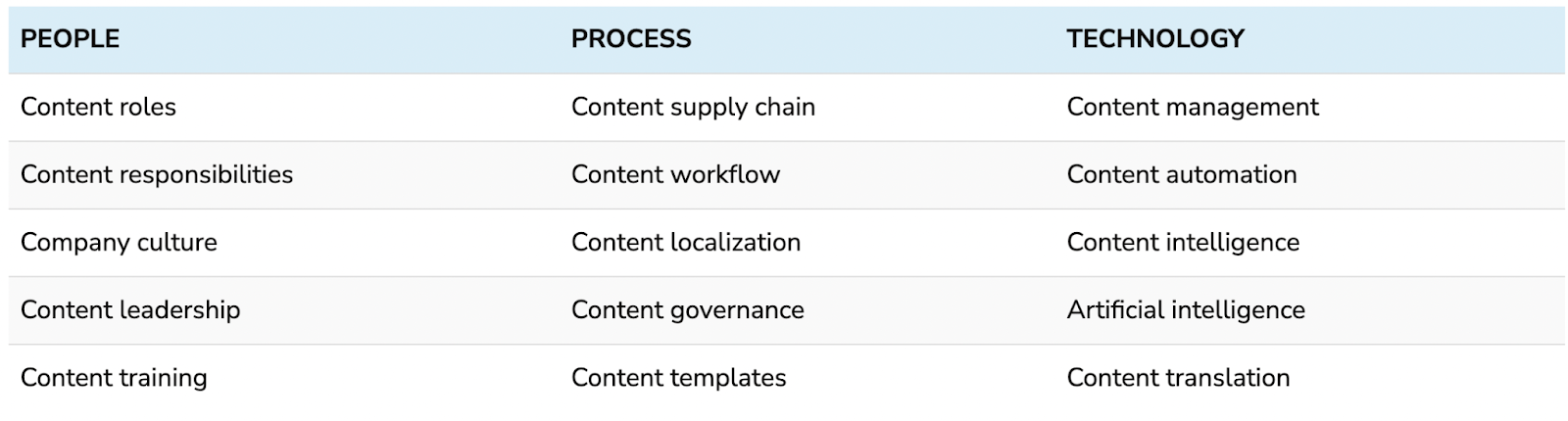
Great content operations generally span three areas. People, process, and technology.
You need all of them working together to keep the ship moving in the right direction.
🎧 Definition: A standard operating procedure is a set of step-by-step instructions compiled by an organization to help workers carry out routine operations.
Why Are Content Operations Important?
The most important reason for content operations is quality.
When you’re producing 800 blog posts a month, you need strict processes to make sure 100 of them aren’t low quality.
It’s easy to think if you publish a lot then it must be bad content. And that there’s not enough time to do proper quality assurance.
But as Gordana mentioned, the #1 thing you need to think about when scaling up content production is, “How can we scale this but keep the quality levels the same?”
“We’re huge nerds, we all studied literature and language, and for us it’s not, you know, it doesn’t matter how much we publish if it’s not good content. That’s our primary concern.”—Gordana Sretenovic, Workello
And, with good operations, she says anyone can do it. Just don’t expect it to go perfectly the first time.
“When we started scaling the whole process, publishing more content, hiring more people to do it, it just became so hard for me. Because I was the one leading the content quality initiative there. It just became incredibly hard and I definitely let some things slip in the beginning before I realized, okay, this is not working.”
“You can't do this on your own. You have to document literally all the guidelines, everything that you want, your writers, your editors. There's just no way for one person to create that much content on their own. So yeah, definitely we had some struggles there and it was not easy building that knowledge base.”—Gordana Sretenovic, Workello
In short, content operations are critical to driving quality in a scaled-up environment.
Why Should You Scale Content Production to This Extent?
Not everyone should scale their content to 100 blog posts a month in month one.
Starting off with 10-20 blogs/month is important because it allows you to iron out the kinks in your processes. Teach your team how to produce really great content, document exactly how, and then ramp the operation up.
Typically, people who want to scale up their content have one goal: to dominate their niche.
“Whatever industry they’re in, they wanna be #1”—Gordana Sretenovic, Workello
How does rapidly producing content help achieve that goal?
In short, more content = more traffic.

There are so many nuances to Google’s Search Algorithm. No one has completely cracked the code, I can’t think of a single website that ranks #1 for all the terms they try to.
For that reason, to scale search traffic in your niche, it’s important that you:
- Produce high volumes of content
- Build topical authority (more content on the same topic = good for all your content)
- Continuously update and refresh what isn’t working
Let’s hear Gordana’s answer on this:
“Some people say you don't need hundreds of pages. Some people say you need hundreds of pages. I think you actually do.
And I mean it's very simple. If I were researching something, whatever it is, let's say in the pet space, my dog is not feeling well and I want to know how to fix their problems. I will definitely trust someone like veterinarians.org. They have so many pages of content. Obviously, you know, they work with dogs. They're a credible brand rather than, you know, sallysblog.com that talks about knitting and then has one article on why my dog is feeling bad.”—Gordana Sretenovic, Workello

"It works like this in academia as well. When you research your credible sources, you obviously want someone who is an established brand. They obviously know what they're talking about. They have a lot of content. So it really makes sense. And when you look at any niche, you will see that all the top players have a lot of content. I'm sure there are exceptions”
Let’s take a look at exactly how to set up your content operations.
How to Build a Content Operation: Three Core Parts
Great content operations have three foundational components:
- Your software stack
- Your knowledge transfer documentation
- Your hiring processes
We're going to deep dive into all three. It's a big one, so buckle up.
But, first, you need to know what you’re signing up for before scaling up your ops.

Creating content at scale is really one of those “you give what you get” things. For example, the more attention to detail you give when explaining your audience, product, and value, the better the outcomes.
🙃 Before we dive in, in this article we ignore keyword research. We’ve covered great keyword research frameworks multiple times already you can check out. Example here.
Part 1: The Content Operations Software Stack
The tools you need in place to scale

Gordana and her team produce 800 blog posts a month.
They couldn’t do it without leaning on tracking, updating, communication, and automation software to smooth their processes.
6 tools they use in their content operations stack:
Workello

Gordana built Workello to solve problems for her own team.
Workello is a skills-testing platform that enables you to optimize your hiring processes. It lets you funnel all your candidates for writers, editors, etc. into one place, track their progress, and automate communication (so you never ghost another writer!)
As we mentioned in our case study with the team who scaled monday.com’s SEO content, “they vetted around 1,500 writers to find the best ones.” Hiring good writers is difficult and this is truly how many need to be vetted to find good ones.
Workello helps manage that process.
Airtable

Airtable is a database tool. It allows you to update and track progress as well as fire Zapier’s automatically.
Gordana’s team uses it for things like content sprint management, content calendar tracking, and storing sources for candidates.
Slite
Slite is an internal knowledge base tool much like Notion. Your content operation relies on your documentation (we’ll get to that later) and Slite can you get out of your Google Docs and professionalize the process.

Zapier
Zapier helps you automate tasks between two technologies. For example:
- Your content writer finishes a first draft
- They update Airtable with “First Draft Complete”
- Zapier connects to Gmail
- Zapier sends an email to your editor to let them know

Gordana uses Zapier to auto-publish content on Wordpress. A huge time-saving when you have 800 new pages to go live each month.
Grammarly
Grammarly is a must for any digital marketer. It’s probably the best grammar and spelling checker out there and can help your team make fewer simple mistakes.
I recommend grabbing the free Google Chrome Extension to get guidance on everything you write—from LinkedIn posts to Google Docs.
GeekBot

Geekbot is essential for asynchronous teams.
It actively encourages your team to report their progress and blockers every day.

Part Two: The Writer Hiring Operation
How to hire great writers at-scale
There’s nothing more essential to producing high-quality writing at scale than hiring great writers.
🤑 Don't miss this free resource: The Workello team spent 27 hours creating a list of 307 free resources you can use to hire niche writers. This list includes more than 50 primary niches and hundreds of sub-niches: 307 resources to help you hire writers.
Here are Gordana’s tips for hiring writers.
In this section, we’ll cover:
- Should you hire in-house or freelance?
- How much can you expect one writer to produce?
- How can you make sure writers are treated fairly?
- Where to find writers in your niche
- What to look for in a great writer
Should You Hire In-house vs Freelance
Gordana noted in our SEO podcast interview that she found it a lot easier to hire in-house because they’ve now established their processes. But it would be wise to start with freelancers first.
Freelancers, especially one-off ones, typically don’t have the time to invest in proper onboarding and deeply understanding your product. They’re juggling multiple clients at the same time.
“I used to be a freelancer, but. When I was a freelancer, I didn't have time to read through pages and pages of documents for one client because I had 10. So at that point, when you actually get everything set up, ask one of them to come and be an in-house writer”—Gordana Sretenovic, Workello
Hiring in-house gives writers the security of paid time off, sick days, and a steady salary so they’re able to invest all their energy in each new client.
However, you should start building your content operation with freelancers.
“But I would not recommend starting out [with in-house content teams]. Don't hire people in-house on day one. Start with a freelancer and if you need one full-time writer, hire three on a freelance basis, because if you work with more people, you will get more surface area to figure out, ‘Okay, first of all, are they really as good as I initially thought they were? Second of all, do they care? Third of all, will one of these writers become my editor?”—Gordana Sretenovic
Gordana mentions this is exactly how she got hired at Content Distribution. She started out as one of 10 freelance writers, became an editor and now she’s risen up the ranks to co-founder.
“What just really matters is that you find that one person that really, really, really cares about this, and then you can start introducing, you know, the PTL and like holidays and Christmas parties and everything else for the people. But you need that one writer to start with and you need the surface area to figure out who that is.”
Her best piece of advice here? Hone your operations with freelancers, and once you’re set-up, hire one of your best-performing freelancers in-house to run the show.
How Much Content Can One Writer Produce Per Month?
The answer to this question is tough, and it really depends on the person.
“Some writers are so fast they can produce one article a day without breaking a sweat, and they're just a natural. I mean good for them. That's like the perfect writer we want.”—Gordana Sretenovic, Workello
You can’t expect that kind of output from every writer, especially if they’re in-house and managing other tasks and taking meetings.
Some people are a bit slower. To fully understand your operation, start by asking how much each writer could happily produce each month—is it 5, 10, 20?
Place them into categories and calculate your total output potential each month, and aim for this.
Writer Ethics: How to Make Sure Writers Are Treated Fairly
We understand that every business wants to keep its costs low. And when producing 100 blog posts a month, that means you likely can’t afford a USA-based writer.

Gordana is from Serbia herself, and advocates hiring people from her country to make sure you both keep costs low and spread the opportunity.
“So I really do believe that you don't need to hire Americans to get that content quality. I think you should give a chance to someone maybe from underprivileged background and kind of not a really nice place to live. I can say it, I’m from Serbia, and it's not a great place. You should give them a chance, they're probably really good, and why not keep your costs down, but still pay your employees a very fair wage? So that is my whole philosophy around that, and I see that a lot more companies are being more and more open to that approach.”—Gordana Sretenovic, Workello

“The cost of living is less in those countries and there are people there who want the opportunity as well. For me, you know, when I was a writer, my goal was really, you know, my country and a lot of other countries, mine is definitely not the worst, the average national salary is really low, but everything is pretty much the same price as Western Europe.”
“So yeah, you really have to fight to get a good job and you know, work these crazy hours. But when you are a content writer you have a little bit more freedom. You can probably work remotely and you can work with a company that can pay really, really well. You know you improve your life. It's just a lot easier. I'm just very, very passionate about the candidate experience, and let's stop viewing Eastern Europe and Southeast Asia is these cheap countries, you know, it's like cheap to live, cheap labor. No, they're really good professionals in these countries who can speak English just as well as someone from the US can.”

4 Places to Find Great Writers

Here are three places you can find great writers:
1/ Job boards
Internationally, there is Pro Blogger which is a great resource for finding writers and editors.
But if you really want to target specific countries, go to their specific job boards. Every country has its national job board or even multiple national job boards.
2/ Interest-based communities
This is probably going to be the most useful for people looking for very niche writers.
Whatever your niche, there’s probably a community for it somewhere. One of my clients is a customer service technology company, and recently I found a community and got 10 new writers in a day with niche experience in customer service.
“You won't get as many candidates as you would on a traditional job board, but all the candidates that you get will be very heavily interested in that niche, and they obviously are very passionate.”—Gordana Sretenovic, Workello
4/ Your customer base
This may be a little bit unexpected, but it works especially well for people that have e-commerce stores or especially niche e-commerce where you have an email list.
“A lot of your customers are probably very passionate about what you sell because they gave you money already. They obviously like you. I had a Workello customer who runs a sports eCommerce for a sport called pickleball. And I'm like, I honestly don't know where you can find people. [So I said] why don't you email your customers and see who maybe be interested in writing for you? And they got 90 candidates. They even had some world champions in the sport.”—Gordana Sretenovic, Workello
💡 Further reading: In this case study "How Monday.com Wrote 1,000 Articles" we deep dive the exact operations used to hire 100s of freelance writers.
What to Look For in a Great Writer? Vetting Your Candidates.
Here are three things you must look for in a great content writer:
1/ Someone who knows what they’re talking about (or a great researcher and learner)
“I don't really care if they have experienced or not. For me, it's irrelevant because I very heavily rely on documentation, even when it's a very niche thing.”—Gordana Sretenovic, Workello
For example, Workello is currently writing a lot of hiring-related content.
They’re not hiring recruiters, they want skilled writers and will use support documentation to teach them about recruitment and where to do research. That only works because it’s an easy-to-learn about the niche, not every niche can do this and will require expert knowledge.
2/ Good communication and someone who cares
It’s critical that if your writers are struggling with something, they speak up and come to you rather than wasting a whole day.
Your ideal writers are clear communicators and easy for you and your team to work with every day.
“What's really important for us is finding people that care about the projects that we're working on. And I was incredibly lucky when I was hiring my kind of first little content team. I found some incredible people, like I'm just so grateful for them because. Those first-time content writers, who never did the job before, and now one of them is my project manager.
Another one is coming very close to being head of operations, and the third one is our senior editor, and they're all amazing women. They're very passionate and the reason why they got there was because they really cared about the content. They cared about the content quality, and they cared about the people that they work with.”—Gordana Sretenovic, Workello
Part Three: All the Documentation You Must Have in a Content Operation
Standard operating procedures are critical to your success
Your enablement and knowledge-transfer documentation is the backbone of every successful operation.
Your first step is to question your client (or if you’re doing this for your own company, your senior leadership team). Your goal is to transfer all their insider knowledge to one centralized location so it’s accessible to all writers and editors.
Foundational documentation
These are your foundational documents:
- About the project
- Client questionnaire, including:
- Who are you?
- What do you do?
- Who are your customers?
- Why do they buy from you?
- What problem are you solving for them?
- Who is the leader in your space?
- How are you different from competitors?
- What’s your strong opinion on your industry?
- Who’s dominating in content right now?
- Do you use specific terminology? (language guidelines)
- What’s the tone you want to go with?

Other key documentation includes:
- Internal link guide (which pillar and cluster pieces to link to for this topic)
- Resources (what can/can’t they reference and link to externally)
- Terminology (don’t use the word best, instead use X)
- Decision-making (who to contact for what and when)
- Editing guidelines, guide editors on exactly what good content should look like.
If you don’t do this, then multiple people in the same company give conflicting information or conflicting feedback. “One guy likes it this way and another girl likes it another way.” It’s not feasible.
Your documentation solves this problem. It should be very tangible, concrete, and easy to understand so that quality is not a moving target.
🤩 I also recommend that you set up a topic-specific questionnaire to send to your clients (or senior leadership team). Ask them questions in a Google Forms that are likely to come up in your content, you can hand off the results to your writers so they can quote your team verbatim in the writing. +1 for original, first-hand expertise.
Creating Content Templates
“I don't know what we would do without them. We probably would not be able to publish anything”—Gordana Sretenovic, Workello
Gordana walks us through their process for creating templates. Their templates are guided first by the keyword research and clusters they’re creating content around.
1/ Keyword research and keyword clustering
When doing your keyword research, you should use a keyword clustering tool to group keywords into semantically-related groups. Because of their close relationship, it’s likely one blog post can win all the keywords in each grouping.
For example, here are 1,000 keywords in the “SEO” niche. I placed them in Zenbrief’s free keyword clustering tool to show you clustering in action.

The output revealed 25 potential topic clusters 👇

“We identify the kind of series or a series of articles that are pretty similar in that vertical or that clustering deliverable that we got.”—Gordana Sretenovic, Workello
2/ Identify content with patterns
When we deep dive into those topic clusters, we might start to see patterns emerge.
For example:
- “Best X tools”
- “What is X?”
- “[Brand] review”
“Let's say we're doing a review series on different brands of earbuds. I don't have to come up with a very unique structure for every single article. If the only thing that's different is the brand name, that's a pretty templatable thing.—Gordana Sretenovic, Workello

3/ Creating a template
So instead of creating briefs for each one individually, we just do the entire series and our editors go in, they do a lot of research beforehand, they, you. Research all those keywords in at, see what else is ranking, and then they start crafting the templates.”—Gordana Sretenovic, Workello
Your template should aim to make each piece of content better than what’s already out there.
“So if my [search] competitors have 500-word articles, I'm going to do 700. If they have one picture per article, I'm going to do three. I'm also going to insert a lot of structured data, you know, lists and tables and infographics and various things like that.”—Gordana Sretenovic, Workello
Their content templates include:
- H2 suggestions (which are changed depending on the topic)
- Research ideas
- Glossary of terms for that niche
- Word count
- When to include a list
- Where to use statistics
The goal is that your writers simply have to fill in the blanks and focus on their creative skills.
If you’re trying to dominate an entire niche and need +1,000 articles, there might be only 50 different types of content. The rest are repeat patterns—so you don’t need to make 1,000 briefs, you can make 50.
Final Thoughts: Assessing The Quality of Your Content Operation
If you’ve got content operations setup and you're wondering how good they are, here are three questions to ask yourself:
- If I disappeared for two weeks, would my team be able to carry on without any issues?
- If two writers fell sick for a week, could I still maintain the same level of output per month?
- Is the content I’m producing something I’d be proud to show the CEO of my company?
If the answer to any of these is no, go back to the drawing board.


