
“I’ve built a thriving business JUST from this revenue-focused content plan sprint”—Brendan Hufford
Here's a challenge for you.
Imagine I'm the founder of a productivity software. We're sales-led, with a sales team to serve and a reasonably lengthy sales-cycle.
I've got some funding and now I want to use content and SEO to accelerate growth.
Where should I start?
This is the exact role play we covered in this week's episode.
My guest is the legendary SaaS SEO strategist, Brendan Hufford. He's worked with the likes of Dave Gerhardt to AngelList Ventures to ActiveCampaign.
In the episode, Brendan teaches us multiple content frameworks to use, as well as the right questions we should be asking before kicking off a new content strategy.
If there's one not to miss, this would be it.
This week, I've broken down the most impactful part of the episode below.
⚡ New here? Check out our fast-growing library of SEO case studies.
5 Step Revenue-Focused Content Framework for Early-Stage Startups
The episode culminates in a super useful content framework Brendan himself uses to win clients. Before we jump into the framework, here are two key points to bear in mind:
Before You Start Keyword Research
Before you actually sit down behind your favorite keyword research tool, you need to craft your offer and truly understand the value of what you're selling.
1. Figure out what your offer is
Brendan notes that often software companies don't fully understand what their offer is.
They see their offer as their software. But what your customer is buying from you is never just the technology. They want a solution to their problem.
“How about you actually figure out why people are trying to buy and then give them the things they need to be successful?” - Brendan Hufford, Episode 10
Crafting an offer is a matter of going deeper and figuring out how you can give your customers true value, and not just a tool to work with.
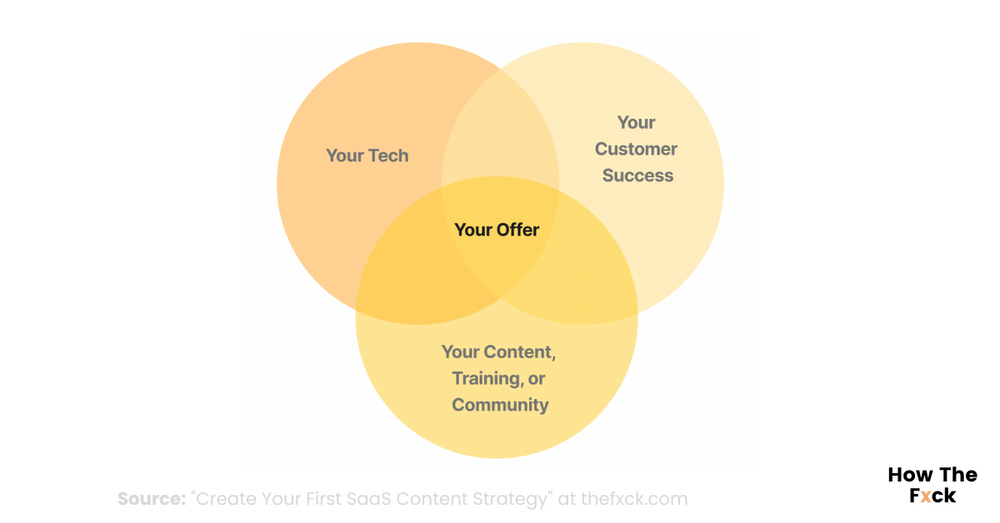
Here are three ideas of what could be in your offer stack:
- An exclusive customer community
- A stellar customer success rep who puts in the effort to genuinely improve the customer experience
- Training that will help your customers become better at whatever they’re trying to be better at
By knowing what the offer is, you can craft a more nuanced content strategy that's part of your offer.
📚 Recommended read: Brendan names Russell Brunson and his books as his go-to for crafting a good offer. Here's a great YouTube video by him about creating mass movements.
2. Figure out what the value of your product is
The second thing that you need to know is what the value of your product is.
Brendan suggests a thought exercise: imagine for a moment that your startup’s product doesn’t exist.
How would you help a friend solve their problems without the tool?
Let’s take a productivity app as an example, one that helps users manage their time and be more productive.
Here is what Brendan says he’d do with their friend without the hypothetical app:
“I’d help them figure out like, how to choose what to work on, right. I’d help them get more done with the time they already have. I’d help them figure out how to get more time.” - Brendan Hufford, Episode 10
By figuring out how to get things done without the product, you identify the “value buckets” of your product.
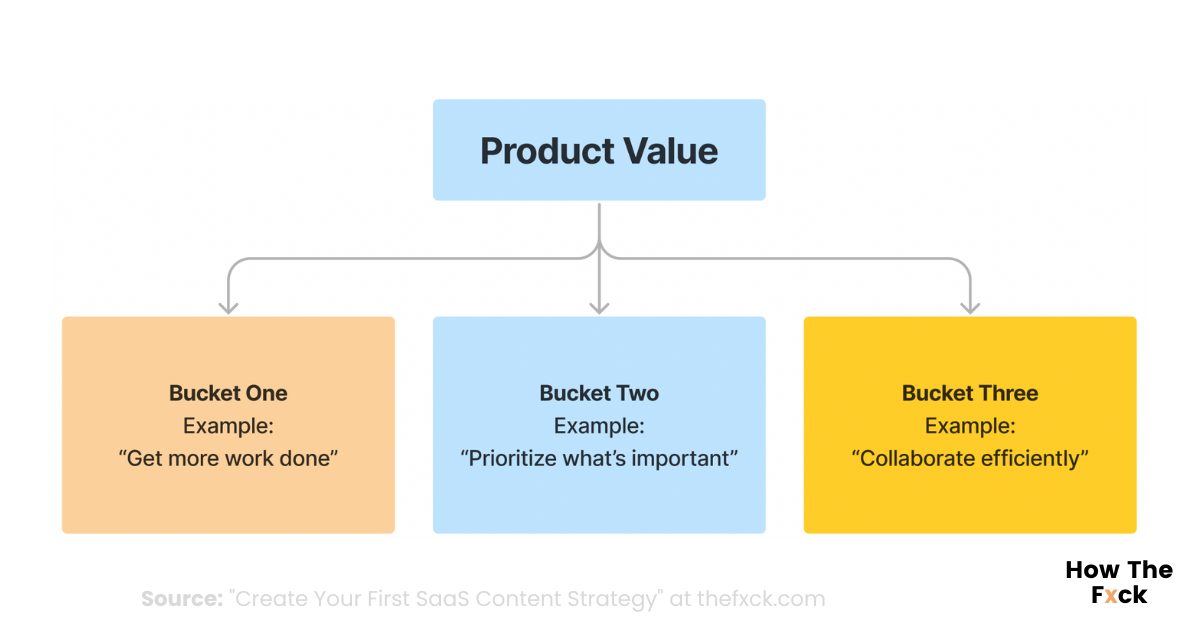
In the case of our hypothetical productivity app, these buckets would be:
- How to get more done
- How to prioritize work
- How to choose what actually matters in our lives, etc.
These act as the foundations of your content strategy. They help guide what topics you should write about and the problems you should help solve for your audience.
💡 Top tip: If you already have a pool of customers you can talk to, they are an excellent source of information to help you define the value of the product.
The 5-Step Framework for Content Success
I've been teaching this one to my clients already. This 5-part framework helps drive problem awareness, solution awareness, and purchase intent.
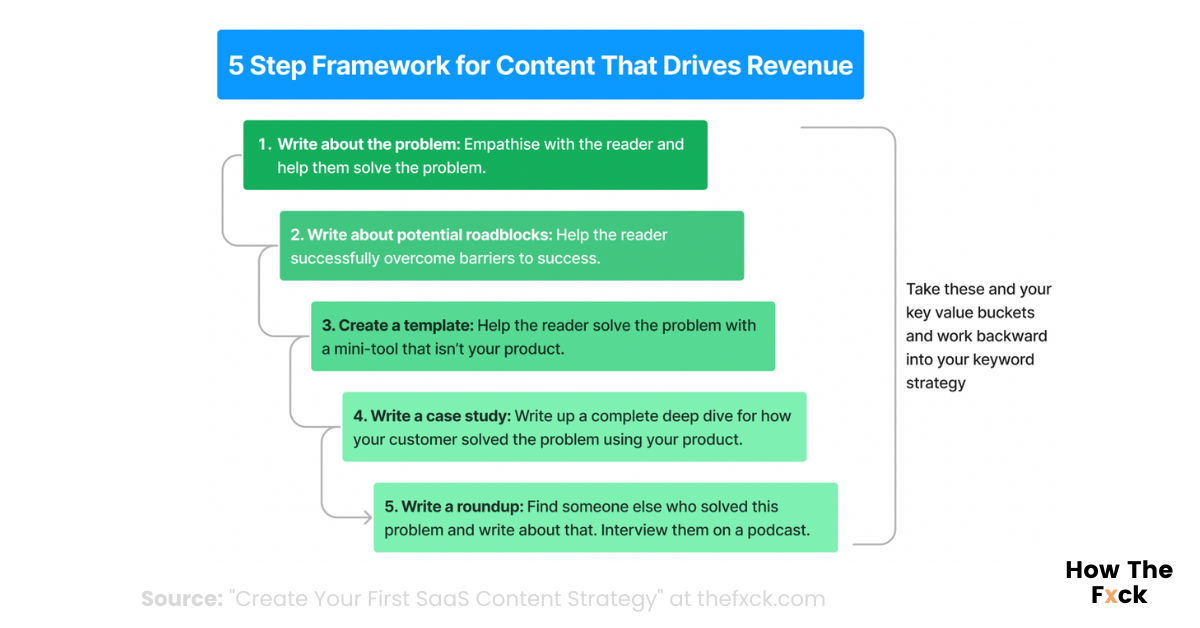
Step 1: Write about the problem
Eugene Schwarz, the author of Breakthrough Advertising, separates consumers based on their awareness levels into five different categories:
- Unaware of their problem
- Problem-aware
- Solution-aware
- Product-aware
- Most-aware

Each level of awareness requires a different content approach.
An early-stage startup usually has no budget to market to people who aren’t even aware that the problem exists. So this group can be set aside for the time being.
In this step, Brendan advises targeting the problem-aware users instead.
When creating content for the problem-aware user, your only goal should be to empathize with them.
“So your only job is just to make them feel like, ‘Oh, thank god, someone like, really gets this.’” - Brendan Hufford, Episode 10
At this level of awareness, the users are not ready to sign up for a demo yet. They want to feel heard, understood, and to know they’re not the only ones experiencing their problem.
“Everybody talks about pain points but nobody writes about actual feelings. Like, lean into that, twist the knife a little bit. Make people feel like, oh, yeah, the world is collapsing a little bit.” - Brendan Hufford, Episode 10
By empathizing with the users, you earn permission to take them a layer deeper, to the solution-aware level.
⭐ Secret sauce: No one says that you cannot, subtly, promote your product even in problem-aware content. But try doing it through visuals: instead of using stock photos to break up your text, use screenshots of your product. Demonstrate with a picture how easy it is to solve the problem with your product.
Step 2. Write about the first roadblock they'll encounter when solving that problem
A user’s journey to solving their problem is not without its hurdles. They're going to hit barriers to success on their journey, it's your job to guide them through.
In this second step of the framework, write about the issues that the user will face on their path to solving the problem.
“‘Once you solve this first thing, you’re probably going to run into this.’ That’s your second article.” - Brendan Hufford, Episode 10
And then help them solve those issues as well.
💡 Discover a new case study: How to Get 2m Clicks in 16 Months in a Tough-to-Win Niche
Step 3: Give the users a template to solve their problem
Create a template to solve the user’s problem without using your product.
It may sound counterintuitive, but, like Brendan says in the episode, people that are looking for a template are not yet ready for the product.
By creating a helpful, ungated but branded template, you are ensuring that users receive value from you and remember you.
When the time comes that they are ready to look into products, they’ll likely look up your brand first.
Step 4: Write a successful customer story
Write an article in which you describe a successful case from your customer base. Show off a specific way that your product helped someone else solve the problem the reader is currently having.
“‘Hey, did you know that we actually have customers that have already solved this problem? Great, here’s that.’” - Brendan Hufford, Episode 10
In case you don’t have a customer story or a case study yet, you can skip this step and go for the last one right away.
Step 5: Write a high-level roundup
In a high-level roundup, as Brendan calls it, you should write about another company (or person) that’s not your client or customer that has solved the problem in their own way.
Find a person or company that stands out in the space and write a profile on them. Interview them for your blog, invite them to your podcast, and help your future users learn from others who are successful in managing similar problems.
🔧 Related Read: 4 Thought Leadership Frameworks to Create Expert Content (by Animalz).
Next up: keyword research
The essence of this revenue-focused content framework is to write these five types of articles for each of the “value buckets” we mentioned earlier.
But instead of starting with the keywords first, start with the type of content first and back up into keywords.
For example, you want to write a case study on how one of your customers achieved impressive results in their business by efficiently prioritizing work using your tool.
Ask yourself: if somebody was searching for this, how would they search for it?
Only when you have an answer to this question should you start doing keyword research.
📚 Keep reading: 5 steps to creating product-led content that converts
Does the framework work?
In Brendan’s own words:
“It’s all that I do. I built a business that I’m really happy and grateful to run - that I think is thriving and growing - all from that.” - Brendan Hufford, Episode 10
For more talk about why SEO doesn’t take 6-12 months and other tips and tricks from Brendan, listen to the SEO podcast episode here.


