
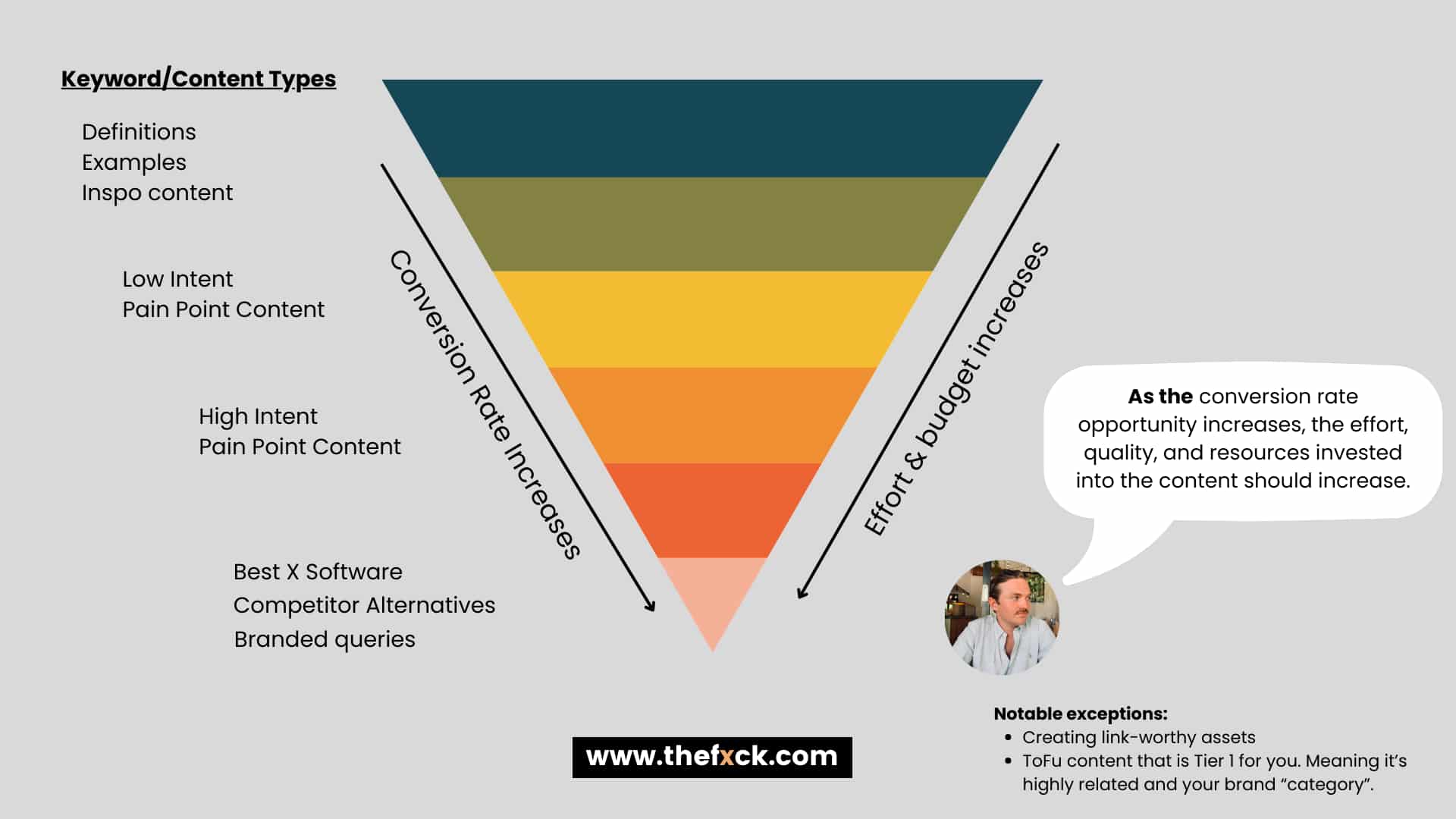
These keywords are literally your best opportunity to win customers.
The "best [x] software" keyword is a rare opportunity to speak directly to people looking to buy right now.

They're already at the bottom of the funnel. They're convinced they need to buy software. Now they're weighing their options.
This is likely the best chance you'll ever get at driving inbound customers through SEO.
So, why are most brands still making awful, boring, untrustworthy content for these keywords?
Hot take: You should be spending 10x longer making content when you KNOW it has high-conversion rate potential.
In this week's article (premium subscribers only), I'm going to show you exactly how I approach "Best Software Listicles".
We'll cover:
- Article essentials
- Reader mindset
- What most get wrong
- My outline template
Let's dive in :)
How to Write Top Tier "Best Software" Listicles
This is my SOP for Best Software listicles (with tips and tricks thrown in).
Article Essentials
- Minimum length: Your blog post should aim to be 500 words on either side of the average word count of the top 5 blog posts on the SERP. Typically 2,500 words.
- URL structure: Keep it simple, focus on the keyword, and remove all the fluff. website.com/blog/best-x-software. Make sure it does NOT contain the year.
- Title: <60 characters, contains the core keyword, and has a unique value proposition. It’s very hard for a user to differentiate if everyone has the same title “Best Pilates Software in 2023”. Assess what’s there right now and make sure your title stands out. Example: "7 Best [Keywords] in 2023 | [Unique Reason to Click]"
Factoring in Reader Mindset
With this keyword, the search intent is pretty obvious. But, what about reader mindset?
The mindset of your reader should be built into all of your content, but nowhere is this more important than software listicles.
By rooting your content in your reader's mindset, you can neutralize their fears and serve their hopes. It helps you create from a place of strength.
Here are some examples of things to keep in mind:
- Your searcher is likely already aware of the top 1-2 big players in the space. If you're a challenger, it could make sense to address this and specifically explain what you do better.
- Your searcher likely doesn't trust you putting your own software as #1 in the rank. It might be better to not say "we are the best overall" - because...yeah, right...but saying "we are the best for X niche audience" or "we are the best for people wanting to achieve X" is much more believable.
- Your searcher is likely struggling to comprehend the vast amount of options in front of them. They need to know some things to really quickly filter: price, industries, reviews, and key features. Don't overwhelm them - make it easy for them with bullet points, lists, images, and summaries.
- Consider YOUR audience. What assumptions, fears, and expectations are they bringing to the table? How can you tap into those in your title, meta description, introduction, and angle to deliver a 10x more gripping article?
What Most Get Wrong (And What to Do Instead)
I've seen many, many terrible best tools listicles.
Here are the most common mistakes:
1/ They don't talk enough about what's actually useful
In a specific category, almost everyone claims to deliver the same benefits.
This makes it very unhelpful to tell the reader how each company describes itself.
When everyone is "the best all-in-one Yoga Studio Management software that's intuitive and flexible"...no one is.
Instead, try focusing on:
- What makes each tool different
- How key features compare
- How well each tool helps achieve certain outcomes
2/ They talk a lot and don't show enough
"Show, don't tell" should be tattooed on every modern content writer.
Especially when it comes to complex products that are hard to understand, visuals are your friend.

Unique images and videos also convey experience. Taking a screenshot of a specific feature you like = damn, this guy actually used the tool.
This comes back to mindset: they expect surface level, so if you can give them in-depth content rooted in real experience - you win their heart.
3/ They try and be everything to everyone
Your product/services should have a unique positioning in the market. A reason to choose you.
Instead of saying “we are the best at everything” because (again) no one believes that, lean into your positioning.
Point out who you are not for (e.g. small businesses with <$50K per month revenue) and highlight who you are for (e.g. fast-growing ambitious business owners).
4/ They're mean to competitors
Just the other day, I saw a brand getting called out publicly for lying about a competitor in their "X vs. Y" article.
You don't want that.
Being mean (or lying) about competitors:
- Entices them to be mean right back
- Makes you look unconfident in your product
- Risks getting called out and damaging your brand
Every company has pros and cons, don't worry to much about sharing your competitor's positives, too.
5/ They don't explain the selection process
Just listing every tool under the sun isn't useful. Yet, most listicles out there just list the same 10 companies without really declaring how or why they chose them.
If your only source of tools is other "best tools" listicles, you are doing this totally wrong.
Instead, create a methodology and process that shows the reader you've put thought into the article.
For example:
- Choose an important pain point (or 5) and score each one out of 10 for fulfilling this pain point.
- Talk to 10 people actually in the trenches using the software and get their real, unfettered feedback.
Both help give the article direction and a sense of coherency.
My "Best X Software" Template
Til now, I've largely focused the guidance on making this a helpful, interesting piece of writing.
But, while it's important to win your audience's heart, it is critical to win Google's.
To fulfill that aim, it's key to nail your heading structure, naturally include keywords throughout the content, and meet search intent.
The template below should give you ample opportunity to do that.
View this template in Google Docs here.
✅ Note: I built this template from looking at several best-in-class blogs, and I largely leveraged Zapier's style as I found their structure super solid. I've also adapted it based on what I've seen work while writing these for several brands. This should be only a starting frame for your article, adapt it to the nuances of your audience.
H1: 10 Best [Software Category] of 2023 | Hint to Angle
Introduction (100 word max):
- Instil trust
- Explain that we tried and tested all of these
- Explain research process
- Address any bias
H2: The 10 Best [Software Category] Softwares
Bullet list summarize the apps with a one-word sentence to describe their unique value. Each one should be a jump link to that app’s core section in the article.
Example:
- CustomerGauge for focus on large B2B brands
- SentiSum for balancing versatility with consistency
H2: What makes the best [software category] software?
H3: What makes a good [software category]?
Here we hit on key points that tie into the audience and their needs, as well as the angle of the post. “I tried to find softwares that balance these 5 things well, because talking to xxx every day we know that [X] is often missing and [Y] is a dealbreaker”.
H2: The best [software category] softwares at a glance
Here we include a 4-column table, summarizing the findings.
Example:

1. [Duplicate as needed] H2: The Best [Software Category] Software for [XXX]
This is where we introduce the first software, in a category of its own around what it’s best for.
Example: Best AI design software for ease of use
H3: Brand Name [Hapana]
- Image
- Summary - make it dead obvious what the tool does and how it works and who it’s for. Try to bring a unique insight to the table, which helps the reader make a decision + show you’ve used it and consider it’s utility for them.
- [Brand name] pros:
- Discuss pros - include screenshots of relevant features
- Include image of real positive customer review from online somewhere
- [Brand name] cons:
- Include image of real negative customer review from online somewhere
- Brand name price
- Real quote
Don’t forget to compare and contrast to our software where possible.
2. [Duplicate as needed] H2: The Best [Software Category] Software for [XXX]
This is where we introduce the first software, in a category of its own around what it’s best for.
Example: Best AI design software for ease of use
H3: Brand Name [Hapana]
- Image
- Summary - make it dead obvious what the tool does and how it works and who it’s for. Try to bring a unique insight to the table, which helps the reader make a decision + show you’ve used it and consider it’s utility for them.
- [Brand name] pros:
- Discuss pros - include screenshots of relevant features
- Include image of real positive customer review from online somewhere
- [Brand name] cons:
- Include image of real negative customer review from online somewhere
- Brand name price
- Real quote
Don’t forget to compare and contrast to our software where possible.
H2: Other [Software Category] Software options
Bullet list options you evaluated but chose not to include. Or alternative solutions they might want to consider.
H2: Which is the Best [Software Category] Software overall?
Conclude here - favorable to our software.
H2: Buying FAQs for [Software Category]
H3: What is [X]?
H3: Why isn't [X] something?
Hope you found that helpful.
I'm taking on a couple of new clients at the moment (which is rare for me!). If you want help building a growth-focused SEO strategy, feel free to reach out.
—Benny


