
Hey friend,
monday.com is well-known for its explosive and unignorable advertising campaigns.
And yep, paid ads were their focus for lead acquisition for 7+ years.
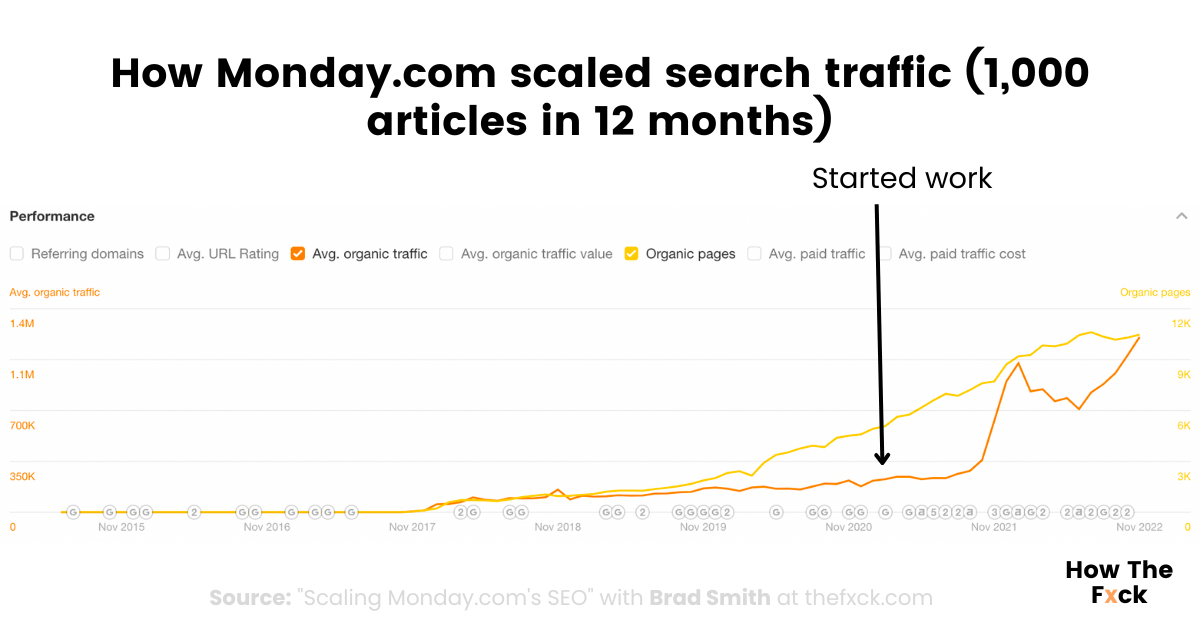
That was until late 2019/2020 when their acquisitions team decided to take their "go hard or go home" approach to a new channel: Organic Search.
In just 12 months, monday.com plugged its content gap with over 1,000 articles.
They targeted keywords across the entire funnel, from "project management tools" to "business risk mitigation strategies" and everything in between.
Long-time How the F*ck members will know, I had the pleasure of interviewing various people to dig into the secrets behind monday.com's explosive scale-up:
- Case Study #1: The content production agency that delivered monday's 1,000 articles
- Case Study #2: The content team lead & SEO managers at monday
We got two different perspectives from these interviews.
Interview #1: focused on the groundwork, initial strategy, and operations.
Interview #2: gave us insight into the results, ROI, and how the strategy has since iterated.
In this week's newsletter, I want to focus on the question of ROI and value.
1,000 articles is obviously not cheap.
But, was it worth it?
1M visitors every month is cool...
But, is it something that's driving results for monday?
You know I love tough questions.
So when I talked with the monday.com team I flat-out asked both of these questions.
And...good news.
Their answers were very revealing.
In this newsletter:
- How big brands like monday think about marketing investments and ROI
- 4 arguments for investing in SEO to add to your repertoire
This should be useful for in-house teams and agencies looking to sell SEO to those with the budget.
👋🏼 This is a free article. If you enjoy it, please help me grow by recommending the newsletter to a friend or colleague. Let's dive in.
How monday.com Justify the Investment in Content Production
When I asked those questions about ROI for this project, there was what felt like a resounding "hell yes" from the monday.com team.
So, let's explore some of the reasons 'why' the team said investing in SEO was worth it for them:
1/ It's a Matter of Perspective
As I mentioned in the opening line of this newsletter, monday.com is well-known for its extensive paid advertising.
In paid advertising, growth experiments are MUCH more common. I've worked in small companies spending $20K/mo on advertising just to see if it works.
Imagine the ad budget of a company like monday?
I mean, I couldn't not see their logo for a good 6 months when I left the house or went online. This is just speculation, but it the budget must have been millions and millions every month.
Now let's imagine how much content costs relative to that?
£500K for 1,000 articles?
£1M?
Whatever it was...that feels like a drop in the ocean for a company aggressively scaling and spending ad budget like they were.
In return, they're getting 1 million+ visitors every single month reading their content.
That's 12-13 million visitors per year thanks.
If they were to pay for those visitors it would be significantly more expensive (Ahrefs data shows that the cost-per-click for the term "project management" is $1.10).
Perspective matters here. When you've got a budget like that, it's worth making big bets to discover a potentially hugely low-cost acquisition channel.
"So when you compare, I know content is expensive but when you compare content to bidding and running ads it pales in comparison. So, when you compare it to the budget for acquisition it was an easy win in that sense."—Zoe Averbuch, Senior SEO Manager at monday.com
SEO returns dividends over years and years, too. It's a significant moat around a business.
2/ Traffic With a Big Difference
SEO is unlike their paid acquisition channel, where every click costs, and when you stop paying...you disappear.
Yes, to stay successful, a search strategy takes constant:
- Maintenance
- Monitoring
- Iteration
But it is not the same thing.
The cost per visitor of an advert stays at $1.10. The cost per visitor via Google Search continuously reduces as time goes on.

Over time, the return on investment only gets better and better. There are huge upfront costs, but then that goes away and maintenance and continuous improvement is relatively low cost.
Once that upfront cost of content is "paid off"...the channel quickly becomes profitable without any more serious chunks of investment.
3/ Things Can Only Get Better
With 1M/mo traffic across 10,000+ keywords, you learn a lot.
Most importantly, you have the data on what drives the most acquisition.
As Eliana and Zoe note in this clip, it was important to them that "we get eyeballs on the blog first and then we'll iterate".
Their quick investment gave them the data needed to create a baseline from which to understand the dynamics of the Google Organic acquisition channel.
This would allow them to identify:
- Which topics to prioritize ranking #1
- Which content to iterate and improve
The explosive nature of the project meant they quickly had data on all types of keywords, topics, funnel depths, etc.
That data is a powerful asset to help hone in and become "cost-efficient" at a later date.
“That's something that Monday really believes in. It's about execution and learning and optimizing as soon as you have a most viable product. You just go with it. So yeah, it wasn't perfect and it's a muscle we’ve exercised a lot since then. We ended up with a lot of duplicate content and keywords that were competing with each other. We definitely learned.”—Zoe Averbuch, Senior SEO Manager
4/ Low Converting Traffic = Also Valuable
This quote from Eliana Atia of monday.com really encapsulates the point I'd like to make:
"We see really SEO as a long-term investment. It's not just another kind of acquisition channel, it's also a brand opportunity. It's a way for people to meet our brand and learn about our product and learn about our company."
Not all your content has to be high intent, high acquisition. (Ref. my newsletter last week on this).
The monday team quickly discovered that many articles brought in the right audience but were too high in the funnel to convert readers at a significant rate.
But that audience can be leveraged in other ways.
Let's say 3% of Monday's traffic converts overall.
That leaves 97% of visitors who either:
- Weren't convinced
- Don't need a new tool
- Don't need a new tool right now
You can't sell something to someone who doesn't need it or want it. But what you can do is become friends with them:
- Capture their email address.
- Send them a weekly newsletter.
- Educate and inspire them—so you're memorable.
Crafting an offer that's relevant to the 97% who aren't yet ready to buy...is how you capture their attention.
Capture their attention now and convert them later when they're more open to hearing about your product.
Performance...and Brand
These four arguments should help you build a case for investing in SEO, whether that's at your company or with your clients.
People commented on monday's strategy that it seemed inefficient, but with these points, it becomes more obvious that their strategy ticks both boxes:
- A performance channel that drives significant acquisition
- A brand channel that drives top-of-funnel interest
It's hard to argue with the value this explosive SEO strategy has brought to monday.com's marketing mix.
How I Can Help You Accelerate Your Organic Growth
1. The Scalable SEO Operation Package: Join 100s of SEOs & Content Leaders inside the Scale Package. This is a comprehensive guide, dashboard and templates for building a scalable content operation that drives real revenue results. I've personally used this system to scale my latest client to 60,000 clicks/month in 5 months—in as little as 2 hours per week of management.
Use code: FRIENDS10 to get a 10% discount.
2. Become a How the F*ck Premium member: Join 247 monthly members who enjoy access to 30+ of the most incredible SEO case studies (and regular new ones). We've heard the inside secrets behind successful growth stories like Hotjar, Typeform, and Monday, as well as incredible niche sites like Living Cozy and Retro Dodo. These stories are how you build a real search-first growth engine.


