
We are well and truly in the age of AI.
AI assistants like ChatGPT and Claude now account for at least 10% of searches made in the US. That's billions of searches per year.
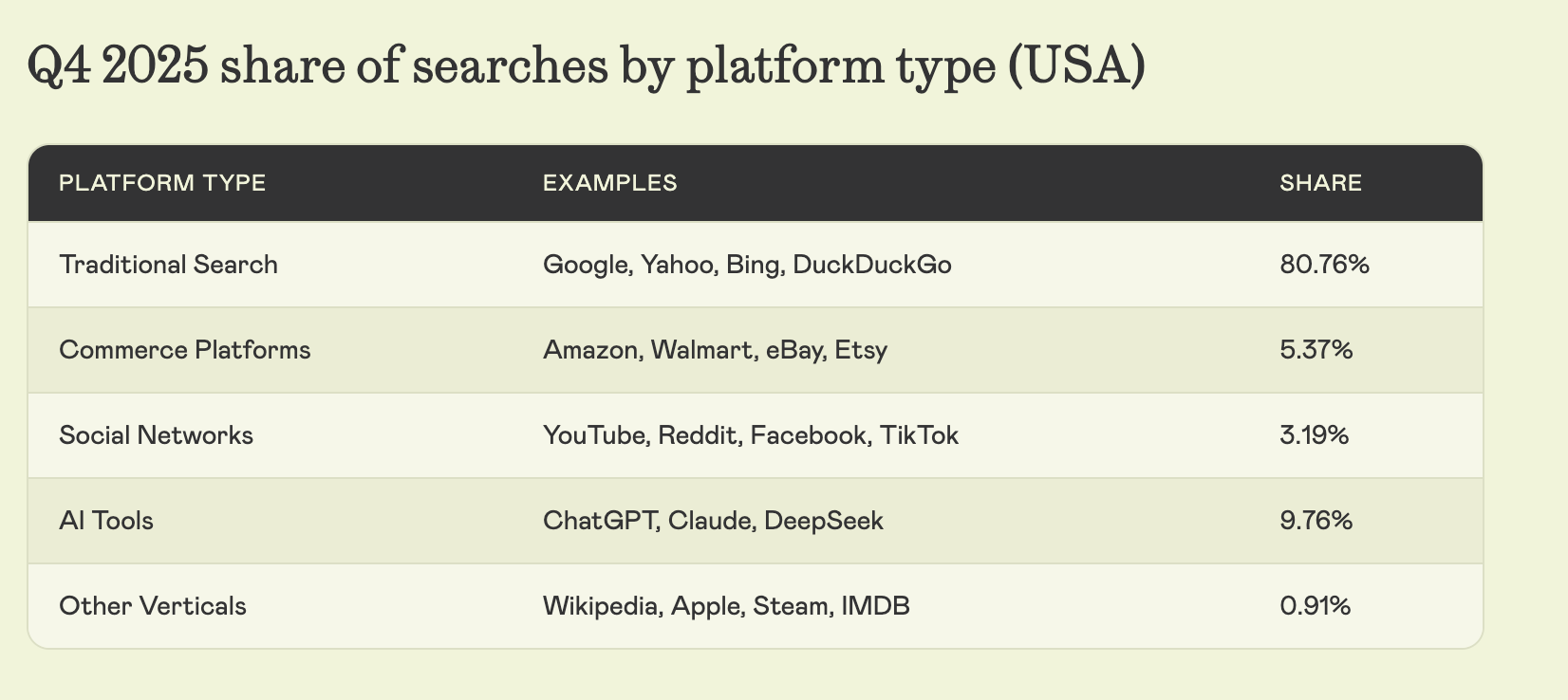
And, with AI Overviews now appearing in more than 40% of all Google searches as well, we can safely say that AI is now fundamental to SEO.
Good SEO is also good AI SEO.
Good AI SEO is also good SEO.
There is no separation.
In this article, we'll show you eight SEO agencies that get it.
They're not trying to sell you AEO without having first been excellent at SEO.
They've simply experiment, innovated and adapted their strategies to include the new services and tactics that have emerged in the wake of AI's steamrolling the SEO industry.
Let's dive in.
What is AI SEO or "Generative Engine Optimization"?
Generative Engine Optimization (GEO) is the practice of increasing a brand's visibility in AI-generated answers.
It focuses on how large language models like AI Overviews, ChatGPT, Claude, and Gemini gather, interpret, and cite information when responding to user prompts.
GEO emerged in response to the rise of AI-powered interfaces that generate answers instead of indexing and presenting content.
Unlike traditional search engines, these tools do not show ten blue links.
They answer queries directly. Only citing sources and recommended brands when appropriate.
The art of GEO is to encourage AI assistants to recommend your brand.
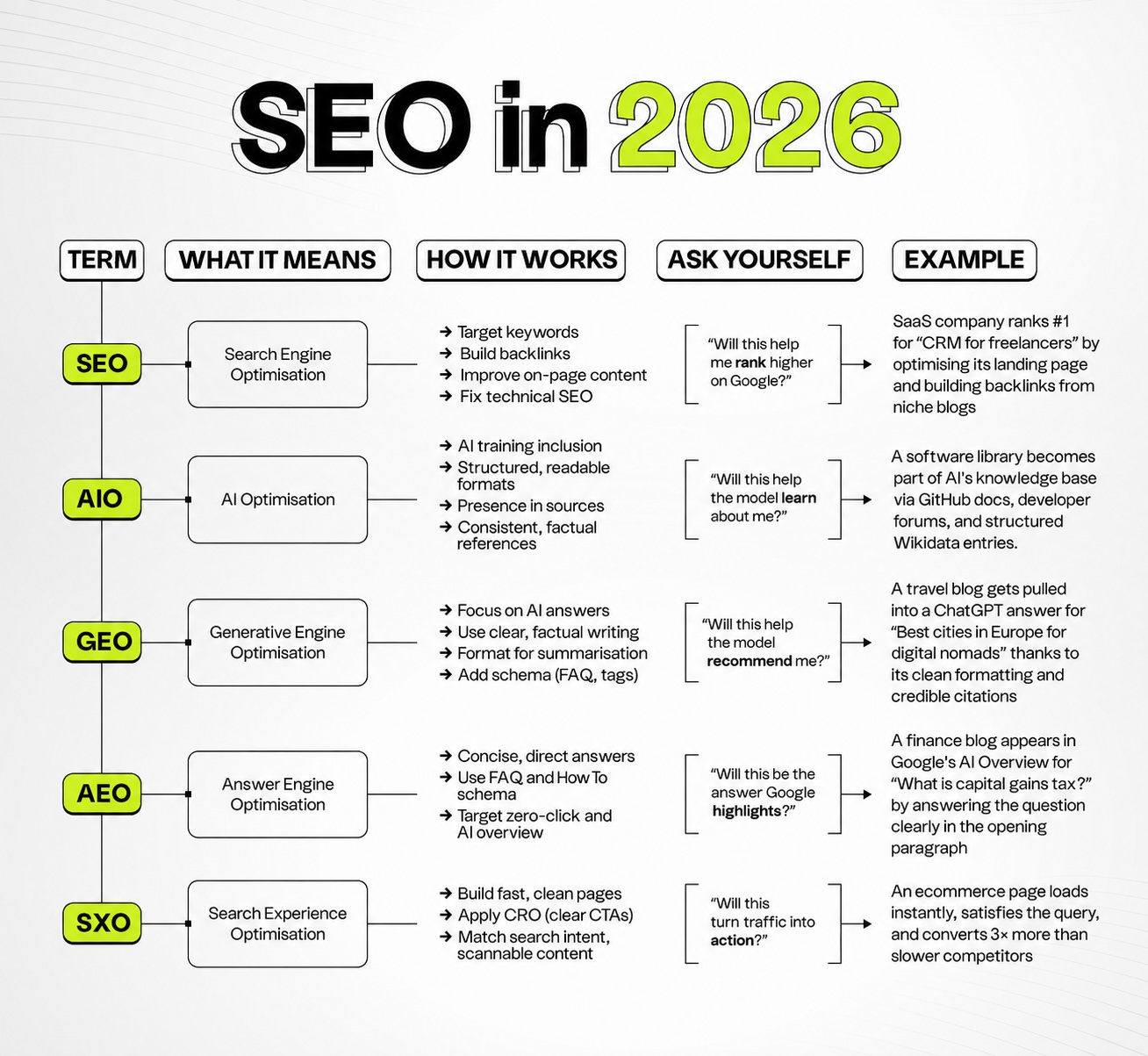
What is the difference between SEO, GEO, and AEO?
This nifty graphic shows you the key differences between SEO, GEO, AEO, AIO and all the other crazy acronyms that people have been using lately.
Who Are the Best AI SEO Agencies in 2026
When evaluating generative engine optimization agencies, we recommend you look for these qualities:
- Highly strategic - this is a new field that requires deep thinking
- Content experts - high quality content is needed for an AI SEO strategy to be long lasting
- SEO experts - you can't separate AEO and SEO, they fuel each other. So hire an agency with an elite level of SEO knowledge
- Revenue experts - do you want citations and traffic, or do you want recommendations and conversions?
Here are the 10 that made our shortlist:
1. Spicy Margarita SEO - Best SEO and AI SEO Agency for B2B Companies

Spicy Margarita is an SEO & GEO services agency that helps fast-growing B2B services and tech companies drive growth outcomes via generative AI tools like ChatGPT, Claude, and Gemini.
Spicy Margarita specializes in bottom-of-funnel SEO strategies designed to drive revenue. Their team has adapted these strategies for generative engine optimization (GEO), helping brands appear when high-intent buyers are actively researching for new products and services inside LLMs.
Spicy Margarita is data-led, fast-moving and focused on results that drive real business growth.
Three reasons people choose Spicy Margarita:
1. Spicy Margarita focuses on bottom-of-funnel AI SEO that converts
Spicy Margarita’s AI SEO strategies focus on keywords and queries used by buyers who are already in-market. This portion of your target audience are looking for a solution, and Spicy Margarita helps them find you.
Their AI SEO services are designed to:
- Capture high-intent organic traffic
- Convert traffic into qualified leads
- Tie rankings directly to revenue outcomes
Unlike generalist SEO agencies, Spicy Margarita avoids chasing vanity metrics like traffic and instead prioritizes what builds your sales pipeline.
2. Spicy Margarita knows how to raise your visibility in generative AI tools
As more buyers rely on tools like ChatGPT and Perplexity for product research, showing up in these interfaces is crucial.
Spicy Margarita helps brands become visible by adapting content for how large language models (LLMs) read, rank and reference information.
Their GEO work includes:
- Structuring content for AI parsing and citation
- Tracking brand mentions inside AI tools
- Iterating based on real LLM output and user prompts
- Optimizing hubs and pages to increase LLM visibility
This is not traditional SEO. It’s a new category of brand visibility work, built for generative search.
3. Spicy Margarita is led by active practitioners in generative engine optimization
Founder Ben Goodey is one of the leading educators in the GEO space. He shares ongoing insights, experiments and strategy breakdowns with thousands of marketers on LinkedIn.
Examples of their work include:
- How to leverage Reddit for AI SEO
- What does a GEO audit include
- Whose job is LLM optimization?
- How to boost AI SEO with a simple trick
The team is also experimenting constantly, building innovative playbooks in the emerging space of AI SEO.
The Spicy Margarita team:
- Runs weekly experiments on LLM behavior and brand prompts
- Uses custom AI measurement tools to track visibility
- Publishes real data on what works inside generative engines
- Brings those insights directly into client strategy
Spicy Margarita is a great choice for those wanting to work with a team at the forefront of how search and AI are evolving.
Clients include
We typically work with enterprise and fast-growing startups:
- Givebutter – B2B SaaS for nonprofits
- Spekit – B2B SaaS for sales teams
- Jabra – B2B electronics company
- Eton Venture Services – business valuation service provider
Reach out to Spicy Margarita here.
2. Skale.so – AI SEO & GEO for Fast-Growing SaaS Teams
Skale.so is a performance-driven SEO and GEO agency specializing in helping B2B SaaS companies increase visibility across generative engines.
Their approach combines technical SEO, topical authority development, and AI-era content optimization to help brands appear more frequently in AI-generated summaries, comparisons, and assistant responses.
Services offered:
- AI SEO & GEO strategy for SaaS
- Topical authority development
- SEO content production
- Technical SEO & site architecture improvements
- Programmatic SEO
- AI-driven performance reporting
B2B experience:
Skale.so works with high-growth SaaS brands in cybersecurity, HR tech, martech, and finance.
Their team focuses heavily on ranking for product-led keywords and ensuring content is structured in a way that AI models can easily interpret and cite.
3. Grow & Convert - Bottom-of-Funnel Content Strategy for GEO and Traditional Search
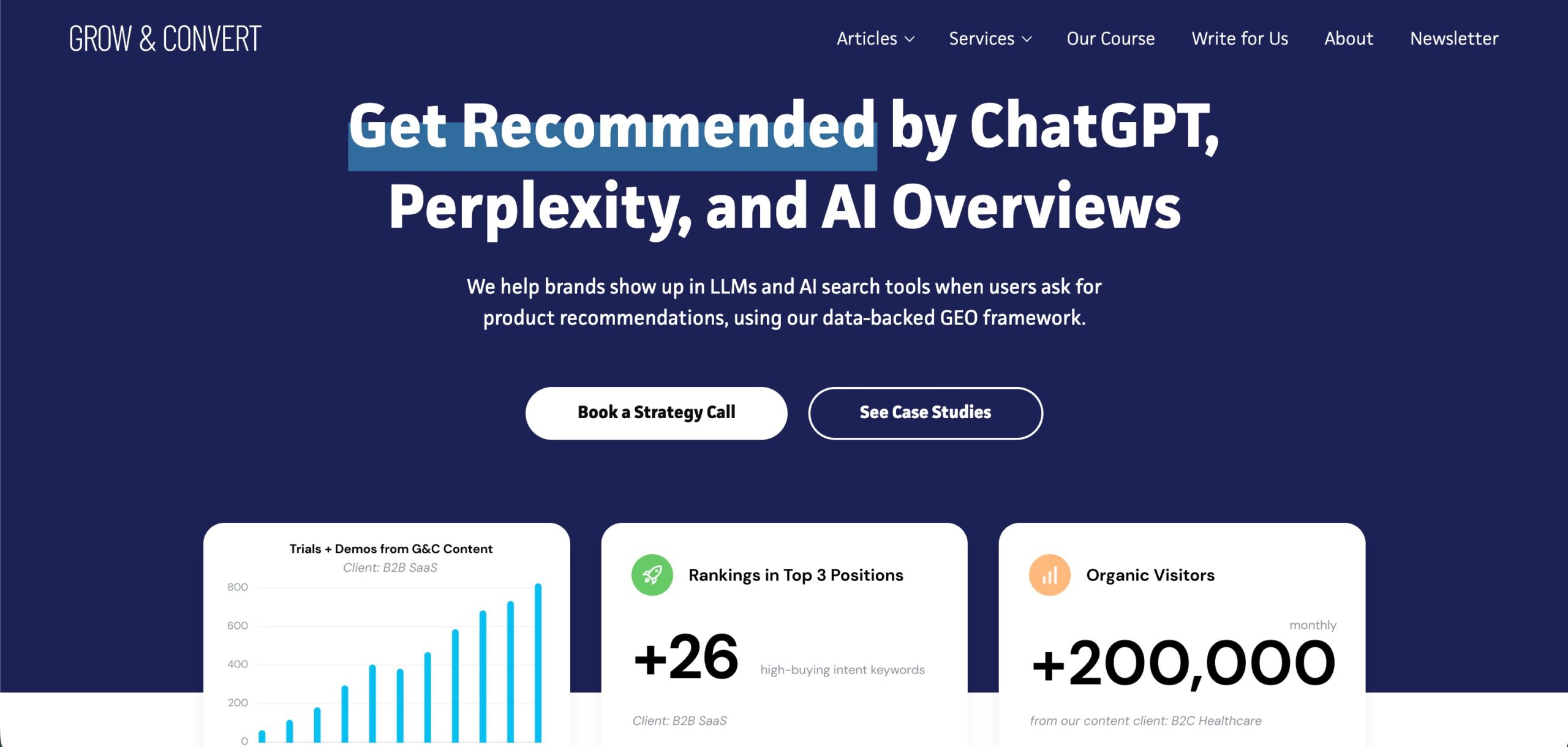
Grow and Convert is a conversion-focused SEO and GEO agency that has expanded into AI search optimization with a research-backed approach.
They developed the Prioritized GEO framework after studying the correlation between Google rankings and AI platform visibility, finding that owned content ranking on page one is the strongest driver of brand mentions in tools like ChatGPT and Perplexity.
Their AI SEO methodology prioritizes building strong owned assets first, then reinforcing them with off-site brand mentions, rather than chasing technical tactics that don't move results.
The agency is known for its Pain Point SEO framework, which targets bottom-of-funnel keywords that buyers are actively searching for solutions to. This same approach extends to their GEO work, where they focus on decision-stage content that LLMs are more likely to cite and recommend.
Similar to Spicy Margarita, Grow and Convert treats AI SEO as an extension of core SEO rather than a separate channel. Their content production centers on comparison pages, alternative pages, and solution-aware articles that answer the questions buyers ask before purchasing.
They track AI visibility using Traqer.ai, their proprietary tool that monitors brand mentions across ChatGPT, Perplexity, and Google AI Overviews weekly at the topic level.
Services offered:
- Bottom-of-funnel content strategy
- Pain Point SEO
- Generative Engine Optimization (GEO)
- AI visibility tracking with Traqer.ai
- Content marketing and production
- Link building and citation outreach
B2B experience: Grow and Convert primarily works with B2B SaaS companies focused on lead generation and pipeline growth through traditional SEO and LLMs. Clients include Leadfeeder, Geekbot, Circuit, Service Titan, Yelp, Wrike, LastPass, etc.
4. Omnius
Omnius is a specialized AI SEO agency that exclusively partners with B2B SaaS and Fintech companies to drive revenue-focused organic growth in both traditional and AI search engines.
Over 10+ years working with SaaS companies, the Omnius team identified a critical gap: agencies were optimizing for vanity metrics rather than revenue. They built a fundamentally different approach that starts with business fundamentals, MRR, churn rate, and CAC, rather than keyword spreadsheets, ensuring content strategies directly impact bottom-line growth.
Their AI SEO methodology focuses on ensuring that brands appear prominently in AI-generated responses across LLMs such as ChatGPT and Perplexity. Because LLM crawlers are less sophisticated than Googlebot, Omnius emphasizes cleaner site architecture, optimized JavaScript rendering, proper schema markup, and enhanced crawlability to ensure AI engines can effectively discover and cite content.
A key differentiator is their proprietary AI SEO analytics software, Atomic AGI, which provides AI visibility tracking capabilities that most agencies lack, positioning them as industry leaders in GEO measurement and optimization.
Services offered:
- AI SEO & GEO optimization for ChatGPT and Perplexity
- Technical SEO optimized for LLM crawlers
- Programmatic SEO for scalable AI-ready content
- Bottom-funnel content targeting SQL conversion
- Strategic link building through AI source analysis
- Revenue-focused performance tracking
B2B experience: Omnius works exclusively with B2B SaaS and fintech companies, including Text Cortex AI, Anna Money, Zencoder, WorldFirst, Meniga, Native Teams, Global App Testing, and AuthoredUp.
Their proven results include growing a SaaS tool from 0 to 2.73 million organic clicks in 13 months, increasing monthly signups from 67 to 2,100+ in 10 months through programmatic SEO, and delivering a 227.9% increase in signups for the Fintech company Myos in just 6 months.
5. Mint Position
Founded by a veteran journalist, Mint Position has a proven methodology for helping fintechs win more customers in the AI era: its “Journalistic SEO” framework.
This approach has one principle at its core: the content that ranks on Google and gets cited by AI is the same content that an excellent journalist would produce. That means using expert interviews and original research that hasn’t been published anywhere else, and winning the trust of wary fintech customers.
This approach is the fuel that powers their Multi-Engine Optimization strategy, which brings topic selection, article structure, keyword targeting, and third-party placements under one roof and calibrates every content decision to earn visibility across both Google and AI search.
Services offered
- SEO 2.0 (SEO + GEO): Multi-engine optimization, including technical audits and BOFU landing pages.
- Content strategy
- Expert interview-led articles and white papers
- GEO Audits: Optimizing for AI-driven search engines alongside Google
- Digital PR
- Performance tracking
B2B experience: Mint Position has worked with B2B financial technology brands including Lula, Duckfund, and Berkeley Payments. Their case studies include building 25 #1-ranked funding pages for Lula, generating 1,000+ B2B organic leads per month, and growing Duckfund’s organic traffic by 300% in six months.
6. Nine Peaks Media
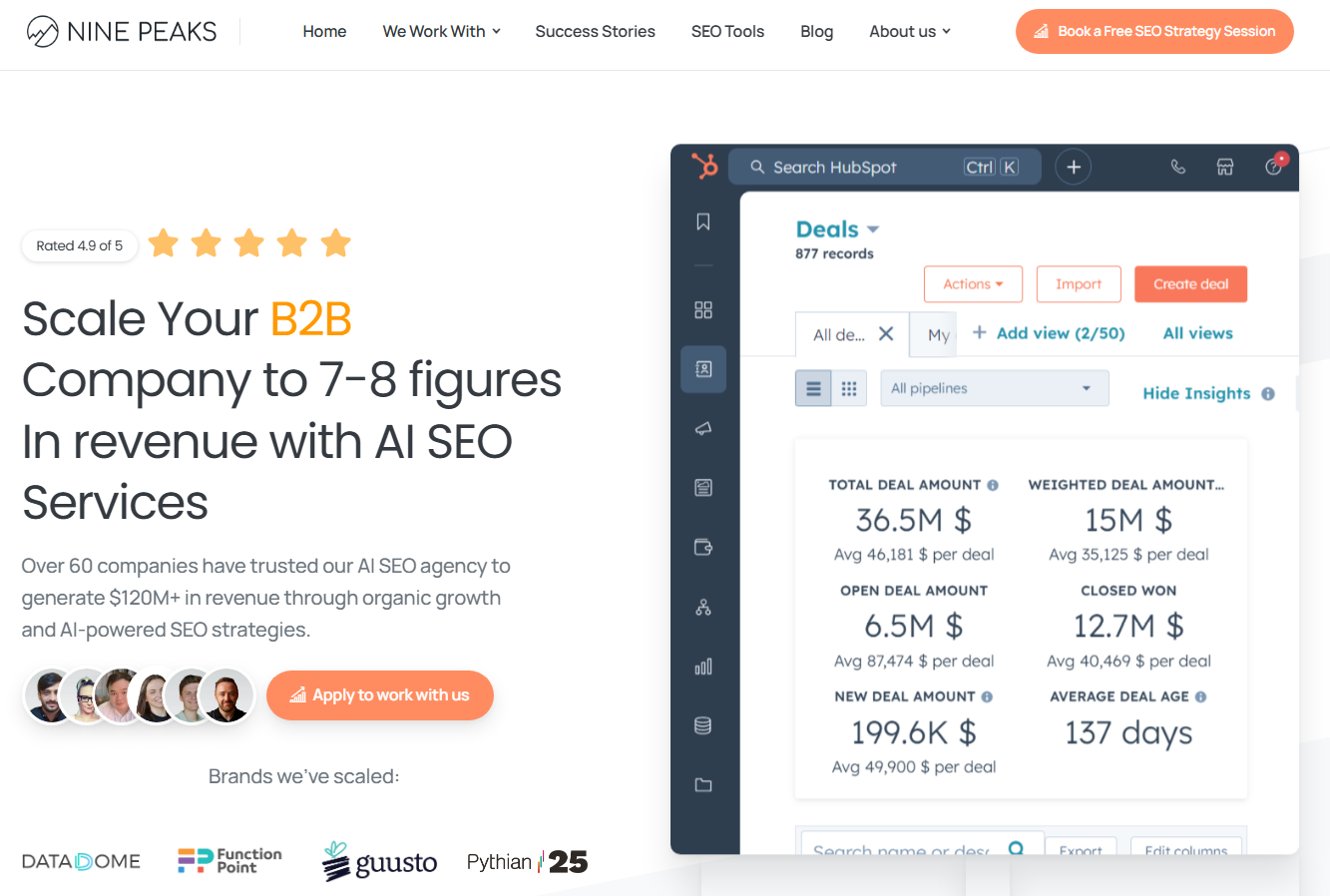
Nine Peaks Media is an SEO and AI optimization agency working exclusively with B2B SaaS and technology companies that want to drive sustainable organic and AI visibility growth. They focus on building long-term visibility through a combination of technical SEO, keyword research, content optimization, AI search optimization and link building.
Nine Peaks Media positions itself as a partner for companies that need more than just classic SEO, integrating organic and AI strategy with measurable results tailored to complex sales funnels.
Nine Peaks Media is a strong fit for SaaS, enterprise software, and technology-driven businesses that want to increase qualified leads and improve search engine and AI search rankings while maintaining a data-driven approach to growth.
Services offered:
- Technical SEO audits
- Keyword research
- On-page optimization
- AI visibility optimization in major LLMs like ChatGPT, Perplexity, Claud, Gemini
- Content strategy
- Backlink building
- Performance tracking
- SEO reporting
B2B experience:
Nine Peaks has deep expertise in B2B SaaS, software, technology, IT and technology markets. They build data-driven and measurable SEO strategies and focus on long-term, sustainable growth from inbound traffic from Google and AI driven search.
Limitation:
- Primarily focused on B2B SaaS and tech companies
- May not cater as effectively to smaller, local, non-technical businesses or consumer-focused brands
Pricing: Custom scope-based pricing with clear deliverables and performance metrics.
7. Notebook Agency
Notebook Agency is an SEO and GEO consultancy that works primarily with B2B SaaS companies and established brands.
Similar to Spicy Margarita, they place particular emphasis on late-stage buyer research and evaluation, where AI tools influence shortlists, comparisons, and final decisions.
Their AI SEO work is anchored in a proprietary system called the Trust Alignment Framework™, designed to move brands from passive AI mentions to consistent recommendation in high-intent prompts.
Instead of optimizing only for visibility, the framework focuses on aligning how AI tools describe a product with verified, decision-critical details such as pricing, integrations, compliance, and ICP fit.
Services offered:
- Generative engine optimization and answer engine optimization
- Trust Alignment Framework™ audits for AI-generated answers
- Structured comparison and alternatives content for AI sourcing
- Entity clarity, schema, and technical SEO to support accurate retrieval
- Ongoing monitoring of AI outputs to correct drift or misinformation
B2B experience: Notebook works with B2B SaaS, fintech, healthcare, and services companies including FreshBooks, VWO, Kneat, Shiphero, and Royal Bank of Canada.
8. Go Fish Digital
Go Fish Digital is a full-service digital marketing agency with a growing focus on Generative Engine Optimization (GEO), layered into a broader SEO, digital PR, and paid media offering.
Their approach is built for scale, making them a fit for brands navigating large sites, complex content ecosystems, and AI-driven discovery at enterprise level.
Rather than treating GEO as a standalone service, Go Fish weaves AI optimization into site structure, content, and off-site authority. The goal is to make sure brands are retrievable, reference-worthy, and consistently cited as AI tools replace clicks with summaries.
A key differentiator is Barracuda, their proprietary AI platform, which helps identify where pages fall short in AI visibility and which changes are most likely to improve inclusion in AI Overviews and summaries. This keeps their GEO work tied to performance, not just presence.
Services offered:
- Generative Engine Optimization for Google AI Overviews, ChatGPT, and Bing Copilot
- Semantic and AI visibility audits
- Technical SEO and site architecture optimization
- Digital PR and citation building for AI sourcing
- Integrated SEO and performance reporting
B2B experience:
Go Fish Digital works with B2B, enterprise, and large-scale brands across SaaS, finance, legal, and marketplaces. Clients include LegalZoom, MoneyGeek, Uber, and Lowe’s, with GEO often applied to high-volume sites where authority and structure directly affect AI visibility.
9. 42DM
42DM is a B2B marketing agency that approaches AI visibility through SAIO (Search Artificial Intelligence Optimization), their term for adapting SEO to how AI systems surface and compare vendors inside tools like Google AI Overviews, ChatGPT, Gemini, and Perplexity.
AI search isn’t just a new visibility opportunity, it’s a traffic loss problem. As AI-generated answers intercept clicks during research and comparison, brands that don’t adapt their existing SEO risk losing visibility at evaluation moments, even if they still rank well in traditional search.
Similar to agencies like Spicy Margarita, 42DM treats AI SEO as an extension of core SEO, not a parallel channel. SAIO is built into technical foundations, content structure, and authority signals rather than run as a standalone initiative.
Their AI-focused work shows up most in comparison queries, tool roundups, and evaluation-stage searches, where AI tools actively influence vendor shortlists and buying decisions.
Services offered:
- SAIO / GEO audits and strategy
- Technical SEO and schema for AI visibility
- AI-oriented comparison and evaluation content
- Third-party citations and trust signals
- Ongoing AI visibility tracking
B2B experience: 42DM works almost exclusively with B2B tech companies, including SaaS, fintech, AdTech, MarTech, and cybersecurity brands. Clients include Payoneer, CloudCall, Zeeto, and Lumin.
10. Intero Digital
Intero Digital is a large, full-service digital marketing agency that has formalized its approach to AI visibility under a proprietary framework called GRO (Generative Response Optimization®).
GRO is Intero’s way of extending traditional SEO into AI-driven search environments. They don’t treat this as a separate experiment, but rather embed it into site structure, entity optimization, content, digital PR, and cross-channel authority signals.
Because of their size and scope, Intero is best suited for mid-market and enterprise brands that need AI optimization integrated across many channels and teams.
Smaller B2B companies may prefer a more focused partner like Spicy Margarita, which applies similar SEO-first principles with tighter collaboration and faster iteration.
Services offered:
- Generative Response Optimization® (GRO)
- Technical SEO and entity-based optimization for AI retrieval
- Structured content and schema for AI citation
- Digital PR and authority building for generative search
- Full-service SEO, paid media, content, and web strategy
B2B experience: Intero Digital works with mid-market and enterprise B2B brands across SaaS, cloud, technology, education, and professional services. Clients include Zayo, Arizona Technology Council, Sunset Learning Institute, and large B2B software organizations operating at national and global scale.
How does AI SEO marketing influence B2B buying decisions?
AI-powered tools are becoming a meaningful part of how B2B buyers research, compare, and narrow down options, alongside traditional search, instead of it.
Recent research shows that nearly 9 in 10 B2B buyers (89%) now use generative AI tools at some point during their purchase journey, whether that’s for early research, vendor comparisons, or sense-checking options before reaching out to a sales team.
This doesn’t mean buyers have abandoned Google or other search engines. It means AI tools are increasingly used in parallel as a faster way to synthesize information.
At the same time, AI-generated summaries are changing how information is consumed. Studies show that when AI summaries appear in search results, users are less likely to click through to individual links.
Instead, they absorb the answer directly from the summary itself. In practical terms, that means the brands and sources referenced inside those summaries often shape buyer perception before a website visit ever happens.
For B2B companies, this changes buying decisions in a few important ways:
- Shortlists form earlier. When a brand is referenced in an AI-generated answer during early research or comparison, it can enter the buyer’s consideration set before a sales conversation or website visit ever happens.
- Perceived authority is shaped early. Buyers often treat AI-generated summaries as neutral synthesis rather than marketing. As a result, brands mentioned there tend to feel more established or credible before formal evaluation begins, even if buyers still validate through traditional search and vendor sites later.
- Research becomes more compressed. Instead of reading multiple articles or comparison pages, buyers increasingly rely on AI tools to summarize options, narrow choices, and highlight differences. This can speed up decision-making without removing due diligence entirely.
Traditional search, vendor websites, and sales conversations still play a critical role. But generative tools now influence how buyers frame the problem and which options feel worth exploring much earlier in the process.
In short, AI SEO marketing influences B2B buying decisions by increasing the chances that your brand is present in the answers buyers are already using to guide their thinking.
What do AI SEO services typically include?
Here’s what a comprehensive AI SEO services program often includes, and many of these are core offerings from the agencies on our list later in the article:
- AI SEO & GEO strategy and audits: A practical assessment of how and where your brand currently shows up in generative tools like ChatGPT, Gemini, and AI Overviews, followed by a clear plan for improving visibility.
- Content optimization for AI citation: Adjusting existing pages so they’re easier for AI systems to parse and reuse, including clearer definitions, tighter structure, and content that works well in summaries and comparisons.
- Entity and semantic optimization: Strengthening how your brand, products, and expertise are described and connected across your site and third-party sources (for example, consistent mentions across your website, comparison content, and places like Reddit or industry reviews).
- Structured data and schema implementation: Technical enhancements that help search engines and AI systems clearly understand your organization, services, and content relationships, increasing the likelihood of being pulled into AI summaries or answers.
- AI visibility reporting and iteration: Tracking when and where your brand appears in AI-generated responses, then refining content based on what models actually surface for real buyer queries.
- Content production for generative search: Creating guides, FAQs, comparisons, and explanatory content designed to be referenced by AI tools, not just to rank for traditional keywords.
- Technical SEO integration: Making sure crawlability, site structure, and performance still support both traditional SEO and AI discovery, since generative tools rely on many of the same foundations.
These service components help brands move beyond simply ranking for keywords and toward appearing in answers, which is increasingly where buyers start their research and evaluate options.
Is GEO replacing SEO?
Generative engine optimization is not replacing SEO. It's changing how SEO is applied in environments where AI models generate answers instead of showing search results pages.
Search engines like Google still exist. However, users now also rely on tools like ChatGPT, Perplexity, and Google's AI Overviews.
These tools use language models to pull information from multiple sources and generate a summary.
The skills used in SEO, such as keyword research, content structure, and technical optimization, also apply to generative engine optimization.
GEO uses those skills to influence how AI models interpret, summarize, and cite information.
Well-structured content that is factually accurate, clearly written, and attributed to credible sources is more likely to be cited in generative results.
This is where strong SEO practices and product marketing can influence how AI systems select content
How to choose the right AI SEO agency for your B2B company
When selecting an AI SEO/GEO agency for your B2B business, consider these factors:
- B2B expertise: Look for agencies with experience in your industry or similar B2B sectors.
- Technical capabilities: Ensure they understand structured data, schema markup, and how to optimize content for AI interpretation.
- Content quality: Review their content samples to ensure they can create authoritative, well-structured material that both humans and AI systems will value.
- Measurement approach: Ask how they track success in generative search environments where traditional analytics may not apply.
- Integration with existing SEO: The agency should explain how their GEO strategy complements your current SEO efforts.
The best agencies will provide a clear roadmap for how they'll improve your visibility in both traditional search results and AI-generated answers.
FAQs About AI SEO Agencies
How do I know if my brand is already showing up in AI-generated answers?
Unlike traditional SEO where you can check rankings on a search engine results page, AI visibility requires measuring citations, mentions, and references inside generative outputs.
There are now tools like Ahrefs brand radar that track when your content or brand name appears in AI answers, for example, how often your URLs, brand mentions, or specific pages are cited by tools like ChatGPT, Google AI Overviews, Gemini, and Perplexity.
These tools can notify you of occurrences, show the context of the mention, and even rank which of your pages are being referenced most frequently.
To assess your current visibility:
- Use an AI search visibility tool that tracks citations inside AI-generated summaries (not just organic rankings).
- Test queries manually in leading AI assistants to see if and how your brand is referenced.
- Compare the frequency and quality of those references over time.
This gives you a more accurate picture of whether your brand has earned a presence inside the answers buyers are consuming.
What does success look like for AI SEO if there are no rankings to track?
Success in AI SEO (or GEO) is about how often and how prominently your brand or content is used as a source or cited in AI-generated answers. That means measuring around:
- Citation frequency: how often your content appears in AI responses
- Context quality: whether your brand is referenced in answers tied to buying intent or product evaluation
- Audience impact: whether those mentions correlate with downstream engagement (clicks, leads, form fills)
AI visibility tools specifically track brand mentions and citations across multiple AI interfaces, and these metrics help you understand how your content performs beyond traditional rankings.
So instead of chasing rankings like traditional SEO, success looks like being present in the answers that shape perception and decision making.
How long does it realistically take to see results from GEO or AI SEO?
AI SEO timelines vary depending on your industry, competition, and the strength of your existing content and authority. Because this field is still emerging, there isn’t a fixed timeline that applies to every situation.
In general, early signals can appear sooner, such as clearer AI interpretation or occasional mentions in AI-generated answers. However, consistent and meaningful visibility, especially for queries tied to buying intent, typically takes months rather than weeks.
Like traditional SEO, GEO and AI SEO rely on building trust, clarity, and authority over time. Large language models tend to reference sources they feel confident in, and that confidence develops gradually as content remains stable, accurate, and reinforced across multiple signals.
The most reliable results come from sustained effort rather than one-off optimizations. Brands that treat AI SEO as an ongoing part of their search and content strategy tend to see more durable visibility as generative tools continue to evolve.
Is AI SEO worth it for smaller or earlier-stage B2B companies?
Yes, AI SEO isn’t just enterprise-only; smaller and earlier-stage B2B companies can benefit when:
- Their buyers use generative tools early in the research process
- They compete in niches where comparison questions are common
- They create specific, helpful, authoritative content that answers buyer questions directly
AI SEO can particularly help smaller brands get seen alongside larger competitors in contexts where AI tools synthesize and cite information from multiple sources (for example, deep guides or comparison answers).


