Most content teams spend far too much time:
- Communicating back and forth with writers
- Editing final drafts that missed the mark
And still, their content never ranks and is not unique nor expertise filled.
In short: many teams are wasting time and energy to achieve poor results.
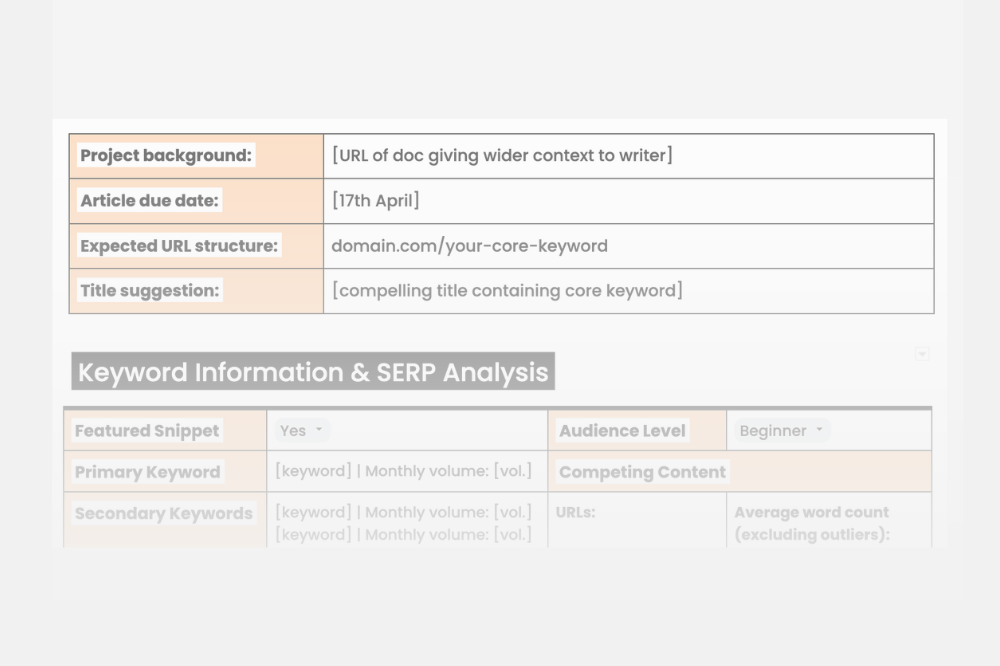
In this article, I provide an SEO brief template and guide to help you:
- Communicate clearly with writers (no nasty surprises)
- Achieve a high-quality article that connects with the reader
- Ensure content is SEO optimized even by non-SEO expert writers
- Ensure your articles have E-E-A-T
We also hear from 6 SEO experts who write for companies like Hubspot, Zapier, Moz, Wordpress, and many more on their best advice for content briefs.
In the final section, I do a video walkthrough for filling out an SEO content brief the way I do before handing it over to any writer who works for me.
Let's dig in.
🔥 The template is right at the bottom of the article. I've also recorded a 20-minute video on "how to create an SEO content brief".
SEO Content Brief Template Goals
I pieced this template together from multiple briefs I've used throughout the years.
I took the best bits from each to create what I think is the BEST SEO brief template available today.
The brief will help you achieve these 9 goals:
Content quality goals:
- Goal: The article has a clear goal. It would move any reader down the funnel.
- Goal: The writer is equipped with your unique differentiators around the product and company mission.
- Goal: Your content doesn't explain easy, boring stuff to an expert audience. It's on-point and relevant.
- Goal: There are clear next steps built into the article, a CTA, etc.
- Goal: The writer is equipped with expert resources from your team, so it fulfills E-E-A-T.
Time-saving goals:
- Goal: You avoid back and forth with the writer. They are empowered to write the best article they can without asking more questions.
- Goal: You get exactly what you expected. You’ve communicated from your head to paper, so they can go away and execute—and there are no nasty surprises once the first draft returns.
SEO goals:
- Goal: The article is SEO optimized and designed to outperform top-ranking search competitors. It clearly fulfills search intent.
- Goal: The article helps with overall site SEO. For example, it has internal links to key pages.
New here? Check out the How the F*ck SEO podcast to learn to scale your traffic.
The Template & How to Fill it Out Properly
In this video, I explain how to use the template and how to fill out the brief to make sure your content is SEO optimized.
First, grab the template here and change your content operation for the better:
💸
Download the template here. Please do not share it outside your organization / with freelancers working for you.
Walkthrough:
8 Experts Share Their Best Practice on Creating Content Briefs
I hounded my SEO colleagues for advice and here are their best answers to these questions:
- What do most people get wrong when creating content briefs?
- What's your #1 piece of advice for those writing content briefs for SEO?
1. Zoe Ashbridge, Senior SEO Strategist
1. What do most people get wrong when creating content briefs?
One of the biggest mistakes is over-briefing, in my opinion.
If your brief is too rigid and asks for too many optimizations you can end up micro-managing your writer, ridding them of creative license, and creating a working relationship where they have to do as SEO says.
Working this way isn’t helpful for anyone but it’s especially poor for writers who will end up writing something unnatural to meet SEO’s requirements. As we know a poorly written, over-optimized piece of content isn’t going to meet its full potential.
2. What's your #1 piece of advice for those writing content briefs for SEO?
What’s better is if SEO worries about the core points they need to express in the article and allows the writer to have creative input.
I tend to think of my briefs as a dialogue between myself and the writer. I’m a writer myself but when working with a writer, as the SEO, I stay in my lane so to speak.
I provide the data points and allow the writer to write. If there’s really a non-negotiable I can let them know, but this is rare.
In practice, this means I don’t overwhelm them with keywords. A good writer will cover the topic fully enough that they’ll naturally sweep them up.
I make recommendations on structures or headings but give them the freedom to move things around. It’s easy when you’re briefing, to think you know how this article should be tackled but the writer will do their own research which is probably more in-depth than the SEOs.
It’s important to appreciate this.
2. Emilia Korczynska, Head of Marketing at Userpilot
1. What do most people get wrong when creating content briefs?
I think the most common mistake I see people make with content briefs is that they don’t include post outlines in their briefs.
A brief that only includes the title, audience, word count, primary keyword, and (rarely, in my experience) - the headings of the paragraphs - is not enough for the writer to create a good piece of content when they are not a subject matter expert.
2. What's your #1 piece of advice for those writing content briefs for SEO?
Outlines should lay out the whole blog post paragraph structure (headings) and talking points, including images, links, and SME quotes to include, and additional resources to read for context. The perfect brief should be a paint-by-numbers recipe for the writer.
Yes, it is time-consuming and may take even around 2 hours to create - but it’s totally worth it as it spares you time later on multiple rounds of revisions, or even having to write posts off when they are simply not salvageable.
If you create very-detailed briefs, you can also hire less experienced (and less expensive!) writers, and achieve similar results as with very seasoned ones."
3. Samantha North, SEO Consultant
1. What do most people get wrong when creating content briefs?
I've seen a lot of content briefs that don't put enough emphasis on SEO. This is a major oversight, because the writer may not have what they need to create an article that will rank.
2. What's your #1 piece of advice for those writing content briefs for SEO?
My number one piece of advice is to write content briefs from an SEO-first standpoint, which means including essential elements such as:
- trusted industry sources for external linking
- summary of search intent, competitor analysis (even if just a basic one)
- ideas for additional semantic keywords (e.g. from Surfer) to include
- FAQs from People Also Asked
If the writer has all this information, it's much easier for them to construct an SEO-friendly article, even without in-depth SEO knowledge.
4. Tim Hanson, Founder of SEO Agency 530
1. What do most people get wrong when creating content briefs?
I think most content briefs are too in-depth. They're too close to a first draft. It's supposed to be brief. The clue is in the name.
Keeping it brief also means what you do define is the most important. The rest can be worked out with the writer. Gives them space to breathe.
2. What's your #1 piece of advice for those writing content briefs for SEO?
Don't put too much pressure on the brief being perfect.
You can't know how it will go down with Google. You can only make the best version of version one.
Know you can and will change it, and that relieves some of the pressure of it being perfect.
5. Victor Ijidola, Content Marketing Consultant
1. What do most people get wrong when creating SEO content briefs?
Creating "copycat" outlines.
It's all too common to see SEO content briefs that are essentially carbon copies of what other companies have already done.
While there is nothing wrong with taking inspiration from others, leading with your own points of view, unique experiences, and individualized insights will help to set your content apart from the competition.
2. What's your #1 piece of advice for those writing content briefs for SEO?
Focus on the user's search intent. It's almost always tempting to fill your briefs with as much information as possible, but it's way more important to understand and deliver content that provides what your target audience is looking for.
The more you do that, the better your content ROI.
6. Melissa Malec, Content Marketing Strategist and Writer
1. What do most people get wrong when creating SEO content briefs?
Most people leave out the company’s unique POV on the topic or some internal data or narrative that can take the piece to another level of value for the reader and stand out from competing content.
Including the company’s unique perspective, data they have that furthers the narrative, or customer-relevant info that could help resonate with the reader is a huge opportunity most companies miss in their briefs and aren’t always things the writer will have access to without the information explicitly provided.
2. What's your #1 piece of advice for those writing content briefs for SEO?
Don’t be overly prescriptive because a great writer will have their own ideas and contributions to the outline, research, etc.
But if you want something included or an angle taken, make sure it’s in the brief.
Writers aren’t mind readers and if it’s not explicitly stated it might get missed. This will cut down time spent on revisions and get high-value content produced faster.
7. Lily Ugbaja, Content Strategy Consultant
1. What do most people get wrong when creating SEO content briefs?
Ignoring search intent. And that goes beyond labeling a keyword as informational, transactional, or navigational. It's understanding what lead to the search, and what the reader may already know. Fulfilling search intent with a holistic view of things is how you maintain your rankings.
2. What's your #1 piece of advice for those writing content briefs for SEO?
Add the answers to these 3 questions for your target audience: What do they know? What do they want to know? What should they know? These answers will help your writers structure and write the piece of content in a way that makes the most sense for the reader. And when you satisfy the reader, you please Google
Ben Goodey, Founder of How the F*ck
1. What do most people get wrong when creating SEO content briefs?
They don't invest enough time in them. Content briefs should empower the writer to deliver a great article within your guidelines of quality and search optimization. Unless you have a good existing relationship with the writer, you can't assume they will just "get" it. Make your expectations crystal clear.
2. What's your #1 piece of advice for those writing content briefs for SEO?
Search intent is absolutely critical. But there are two areas I highly recommend including in every content brief:
- Expertise: Add quotes, original data, or something else to the brief for the writer to integrate into the content. Collect this from your team.
- Word count: Be super clear about the word count for each section. You don't want your writer to spend 80% of the article defining "what is X" when you intended the article to be a how-to guide.


