
Erin Balsa joined the podcast & community this week.
I've known for a while that Erin shares my aversion to putting out content that’s not unique and high quality.
Both of our standards for minimum viable content are pretty damn high.
In Erin's world, quality SEO content is critical.
Her clients are B2B software startups that sell complex, enterprise solutions.
...which is about as far from an impulse purchase as you can get.
B2B enterprise software is an expensive, long-term decision. A lot of trust and authority is needed to push the sale through.
Generic content just won't cut it for an audience like this.
Luckily for us, Erin's also worked as a journalist and built a team of 10 writers that pushed out quality content at scale.
So, who better to teach us to scale quality SEO workflows than Erin?
In this article, you can expect to learn:
Part 1: How to build SEO topic clusters that epitomize quality (a framework that drove 789 leads/month for me in my last role)
Part 2: The “how” behind a research report that drove $680k in closed business for Erin
Part 3: Building thought leadership into a Velocity SEO workflow
Let's dive in.
🎧 As usual, I expand here on the podcast interview to add graphics, stories, insights, and clarifications. But I recommend you listen to this week's episode, too. Erin's a real pro and our discussion really gets into it.
Part 1 - Building a Thought Leadership-Led SEO Content Strategy
🔥 What is thought leadership content? Thought leadership content is a type of content marketing produced by subject matter experts intended to provoke new ideas, inspire change, and provide authoritative insight within a specific industry. This content aims to demonstrate an organization's or individual's expertise, build credibility, and position them as an authority in their field.
I asked Erin if she was tracking updates on Helpful Content and E-E-A-T, and this was her response:
“Honestly, I don't worry that much about it because that is at my core what I do. I'm someone who would never just like let an AI writing tool, write a blog post and just do a quick edit and like be like, yeah, that's fine. It's good enough. That's just not how I operate.
So for me, expertise, authority, and trustworthiness is just at my core, what I do and what I demand from my team. Back when I used to manage writers, it wasn't enough just to put out content volume. So I don't personally pay too much attention to that cuz that's just for me, like, no shit. Of course, I'm gonna do that.”—Erin Balsa
This is much easier to do when it’s your own content, but when you’re working on behalf of a client it’s easy to let standards slip without a system in place.
When Erin builds a content strategy that includes SEO, she helps her clients strategize systems to inject thought leadership into each piece of keyword-optimized content.
There are a few ways to do that, but one of the best ways is to write a quarterly or annual research report and use the findings as foundations of 6-12 months of SEO content.
This suggestion reminds me of how I structured content in my past role at CustomerGauge.
When I joined, there was a library of quality eBooks that were getting dusty. They were on all sorts of really relevant, meaty topics.
So I built an SEO strategy that covered those same topics. We used the unique data and insights as the foundation of each topic cluster and then used the ebook as the "downloadable" that captured the traffic.
Here's my visualization of that strategy (I'm calling the idea of using one piece of thought leadership to drive unique insights into a whole topic cluster: Thought Leader SEO).
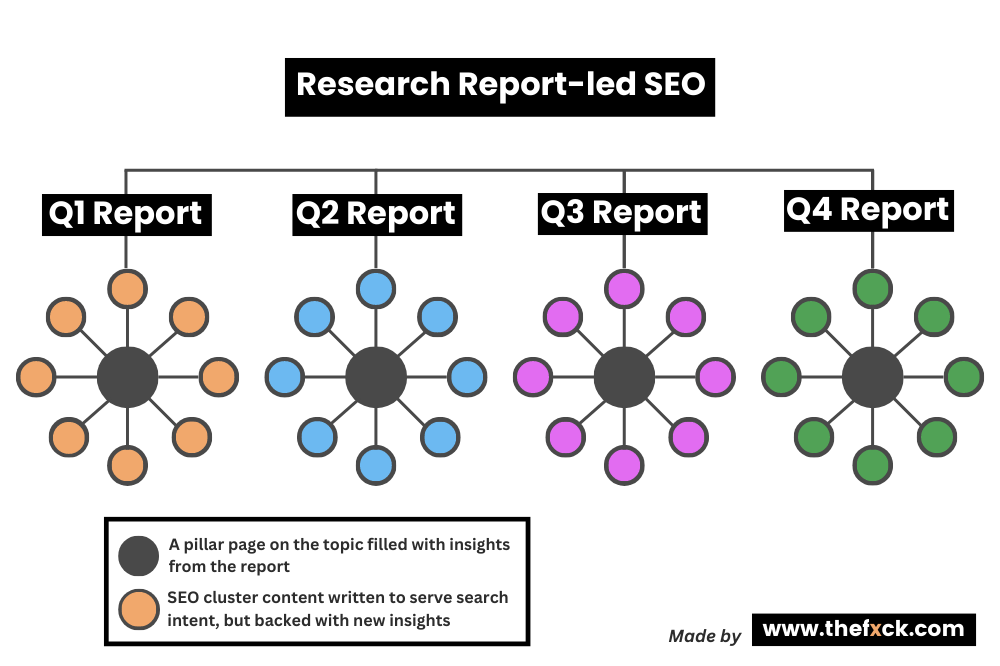
Erin details a similar strategy in the interview, noting that one strong report can be used to “beef up” tons of SEO articles on that topic with insights and data points.
That way every single article is unique and can’t be found anywhere else.
“If you're ranking for a keyword and you're putting out the same generic information as everyone else, that's fine. Your blog can rank. I see it happen all the time.
But yeah, who cares about ranking if you're not hitting your numbers? At the end of the day, that's what matters. You can go brag that you've got all these blog posts to rank on page one, I used to do that, but at the end of the day, if none of those page views are leading to conversions or leads for the sales team, or high-quality leads that the sales team can actually close, then what good is the traffic?”—Erin Balsa
To stand out and connect with an enterprise audience in search, every SEO article needs to stand out with data that pushes that reader’s knowledge forward.
Part 2 - How to Create a Compelling Research Report
I asked Erin to tell us about a research report she created for Predictive Index in 2020 that helped close 114 opportunities, bringing in a total of $680,000 in revenue.
When the software you’re selling is complex and expensive, your audience needs to trust you and the value your product offers.
A strong piece of thought leadership like a research report helps do this.
Erin (who has a course on writing research reports) notes that the report had four attributes that made it so effective:
1. It’s timely
The Predictive Index report was about helping people work remotely for the first time, managing the complexity of motivating a team in a remote environment.
It came out in mid-2020 when this was in dire need for Predictive Index’s target customer.
2. It’s helpful
The Predictive Index report offers unique insights (“net new information” they couldn’t get anywhere else) and actionable tips (how to act on those insights).
The report touched on employee retention and saving money—all important in a potential economic downturn.
3. It mapped to the product
The Predictive Index product helps companies understand their employee’s behavioral drives.
They used their own frameworks, combined with original survey data, to show off a use case of the product.
Mapping the report to the product meant:
- Prospects in the “consideration” phase saw even more value from the product and closed faster
- Existing customers got a new use case which improved retention
- Brand new prospects discovered the platform and what it could do
4. It was unique
The insights offered in the report were unique to Predictive Index. They collected data from their user base and used their own methodology—no one else could’ve made this report or offered this value.
Together, these 4 attributes meant the report connected with a reader and accelerated the company-prospect relationship.
This all applies to SEO content, too. For starters, all SEO content is technically “timely” because it’s served in the moment of need.
But most SEO content fails the helpful, unique, and product-related sniff test. This is where most strategies need to adjust.
Q: Does AI content work for complex enterprise SaaS?
Part 3 - How to Bring Thought Leadership Quality into a Velocity SEO Workflow
In the interview, I challenged Erin to help us build an SEO workflow that prioritizes both quality and speed.
She has experience doing that in the past, where she managed a team of 10 writers with a strong focus on quality editorial content.
Here’s what she said:
Tip one: Have a strong editorial process.
We know this one well in this community.
Your writing team should not be making “on the day” decisions for what to write. Guesswork doesn’t scale.
Your content team needs:
- A long-term plan
- Clear roles
- Detailed briefs
- Unique insights to use
This is where building a quarterly plan around a thought leadership report works wonders. Everyone knows that quarters plan and their source of unique insights.
Read my guide to content operations to learn how to build an editorial process full of efficiency-driving SOPs.
🔥 Relevant Download: I interviewed 8 experts and created the ultimate SEO content brief here (with video guide on how to use it).
Tip two: Have a well-documented strategic narrative.
This is one we rarely spend enough time on here, but it’s probably the most important piece of documentation.
I first stumbled onto the “strategic narrative” way of thinking thanks to Andy Raskin’s “the greatest sales deck I’ve ever seen” (who is also great to follow on LinkedIn by the way).
What is a strategic narrative? In Harvard Business Review it’s defined this way:
“A strategic narrative is a special kind of story. It says who you are as a company. Where you’ve been, where you are, and where you are going. How you believe value is created and what you value in relationships. It explains why you exist and what makes you unique.”—HBR
Why is this important for scaling content with quality?
A big part of what makes a piece of content “quality” is that it’s uniquely yours and connects the reader to your brand. Without those things, you’re giving value but the “you” behind the value is easy to ignore.
With a well-documented strategic narrative, that is understood and continuously re-iterated with writers, all your content can live and breathe your special kind of story.
“I have a lot of clients now that either have or are in the middle of developing and honing this really strong narrative.
At Predictive Index, we were very lucky, I'm not sure if you're familiar with the book Play Bigger, but we were able to hire an agency that does messaging and positioning owned by one of the authors of Play Bigger, which is like the definitive guide for category creation.
We were very lucky. I got to see firsthand what a truly brilliant and powerful narrative looks like. It was a great education for me and I was able to then incorporate and help my team incorporate this long, powerful, engaging story into all of our content.
So even if we were writing SEO blogs, they were different because they had this magical, aspirational, relevant story. So that was for me, kind of the magic piece.”—Erin Balsa
Without a clearly documented strategic narrative, it’s hard for a freelance writer to really get and invest in your story. Then your content slips into being generic.
“The hardest thing about being a writer, especially as an agency writer or maybe a freelancer working with multiple clients, especially early in your career, [is that] the more clients you have to work with [the more you get paid].
So here you are working with five 10 clients and you're just doing the best you can to pump out these articles. There's just really no time to wrap your head around the whole story behind the company, the product, et cetera. So when you have this really well-documented story, writers can read it again and again, memorize it.”—Erin Balsa
How to Create Your Strategic Narrative Documentation
The problem of “I’m trying to pump out content so I have no time to do it properly” is exactly why strong documentation is important in a velocity SEO environment.
We’ve heard that in almost all our case studies so far. Quality comes from documentation.
For example, these three really stressed the importance of quality, customer-centric workflows, and processes:
- How Monday.com Created 1,000 Articles in 12 Months (and part 2)
- How Living Cozy Grew to 335K Visitors/Month with Expert Content
- Hotjar's Traffic Explosion: 47% Increase in 2 Years
However, the difficult part of a strategic narrative is that a Head of Marketing, SEO agency owner, or Content Manager can’t build one alone for their company or clients.
It’s strategic which means the whole company—from product to comms—needs to be on board on heading in the same direction.
Strong documentation in this area includes:
- The problem: What customers are facing and how you believe they should solve it
- The product: The end-to-end product suite, your product roadmap, and why it’s all like that
- The why: Why does your company exist
These elements can be weaved into every article in some shape or form and will help the reader understand your way of seeing the world.
I always create an internal guide with my clients with captures the essentials:
- Our services: What we offer and their value you
- Our audience: Our target audience and the problems they face
- Our POV: Our point of view and way of thinking about common industry talking points
These, at the very least, allow writers to remember what you do and why each time they sit down to write.
Learn more from Erin
Like learning about content and SEO from Erin?
She’s got a world-class newsletter, podcast, and course:


