
This one may surprise you:
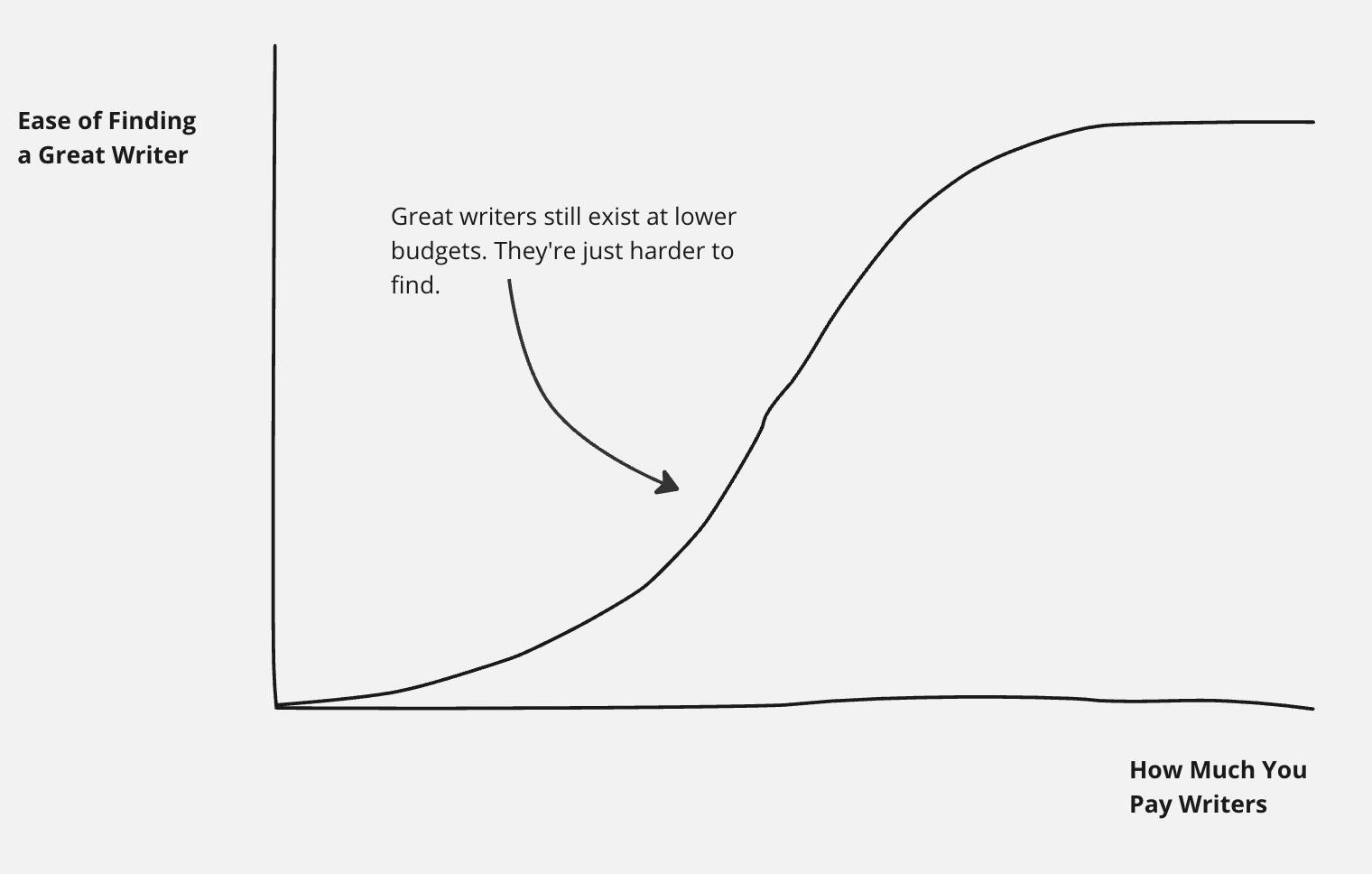
It's not always true that the more you spend per article, the better the content will be.
Sometimes you have a writer who will charge $2500 an article, but it will still be really average.
Or you could have a writer who charges $300 and makes some of the most helpful, creative writing you've seen.
Yes, it's significantly harder to find great writers at that price.
But it is possible.
In this week's newsletter, I'll share with you some tips for improving your chances of finding great writers at more affordable rates.
💡 Writers are the cornerstone of every great content operation. They deserved to be paid well and fairly. The good news is there are writers available for every budget—this guide is to helping you find the best at your budget.
How to find, hire, and keep hidden gem writers (at rate you can afford)
Here’s the trick:
1 | Set your per-article rate.
Everyone has their own budget. Some have WAY more than others. Lucky you.
But knowing your per-article rate means you can state upfront, "this is the max we have available per article, don't apply if this rate isn't for you."
I’d recommend something around $500 for 2,000 words. That's the sweet spot (assuming you have thorough briefs, research processes, and editing in place).
In my experience, if you go lower than $500 it's very hard to find writers who deliver sizzling content on time.
2 | Advertise widely—fill your pool with as many applicants as possible. You're looking for that 1 in 500.
I always get 100s of applicants when posting in places like:
- Upwork
- Slack groups (e.g. Superpath)
- Niche Facebook groups for certain topics
If you're not going super cheap (like $100 an article), you'll get lots of applications.
You should expect 95% of those will be totally terrible—I'll share my process below for vetting these out ASAP.
3 | Test writer applicants (rigorously).
Let's say your budget is $500 per article and your advert gets 100 applicants.
You have to believe that you'll find that ONE writer.
The needle in the haystack that is going to be really, really good at the rate you want.
To find that writer, you need to find a way to reduce all the writers who don't meet your standards—time wasters, poor quality writing, uncreative, lack of research skills.
This is where rigorous testing phases are important. In my eBook on "how to scale content production", I detail every stage in my writer hiring operation and all the email templates for each step.
Here's how I shortlist candidates from the first application stage:
- Scan through the applications and remove any that didn’t follow my instructions for 80-100 words about their "pet or favourite job"—check my advert above if this doesn't make sense.
Around 50% get removed with that scan alone. A lot of people auto-reply with a copy-paste instead of reading the advert.
If they can't follow simple instructions, how can we expect them to understand and apply all of our knowledge transfer documentation?
- My second scan uses an AI scanner to look for use of AI and plagiarism.
I explicitly ask for no AI, so I put all applications in to verify. You can usually tell if it's AI-written as it's still obvious to the human reader.
- My third scan is a personal ‘sense check’:
Did their application convince me? Were there obvious spelling mistakes?
Any weird writing, like applying with “Dear Sir” which shows a lack of situational awareness
Did they have good reviews?
Is anything else slightly off?
Seriously, only shortlist writers you are confident about. Any rumbling gut feelings? CUT THEM OUT. This will save you A LOT of time (and wasted money) later down the line.
The next stage in my applicant vetting process I recommend you never skip.
--> A mini-writing test.
I ask every promising writer to do a short, 200-word writing task.
I give them a detailed content brief, style guide, and content quality checklist—this helps you see their writing fresh. Not the polished, edited ones in the portfolio.
This final mini-test stage also reduces your candidate pool by another 50%.
4 | Onboarding—Set your minimum standards for quality
When working with writers, it pays dividends to be crystal clear about your expectations for quality.
So, ask yourself, what does "quality" mean for you?
Can you identify what it is and what it isn't?
If not, how do you expect new writers to do it?
I always recommend you set your bare minimum standards for content quality.
Make a checklist. Write an example piece.
Make it obvious to everyone what your minimum for quality is.
Then reinforce it continuously.
Onboarding across tone of voice, product, and expectations is a key part of hiring writers at scale and them actually delivering the quality you need.
5 | Scaling up—Moving your team beyond writers
When you're scaling content, especially if you're getting really, really aggressive, you need multiple people involved.
You can’t expect your writers to write an article every day AND write briefs, edit, content, and publish it.
In my interview with Gordana Sretenovic, she recommends that there is one editor for every two writers. Several other interviews echoed this advice.
Key people to keep in mind in your operations:
- A team of writers
- An editor (1 editor to every 2 writers)
- A project manager to manage the process
- A strategist to do the upfront work and continuously evaluate opportunities
Final tips:
- When you find good writers, keep 'em. Writer retention is the biggest scalability hack because doing all this hiring constantly is exhausting and slow. (How? Pay people quickly, communicate clear, give feedback, take feedback, and be nice.)
- Overinvest in crafting killer briefs. If your briefs are in-depth, writers nail it from the start. When it gets to the editing stage, no one was unclear along that journey. So there's hardly any editing to do.


